Developer APIs
LLMWise is a cutting-edge multi-model AI chat platform designed to provide transparent, cost-optimized access to a wide array of large language models (LLMs) from a single, unified interface. It empowers users to leverage models like GPT, Claude, Gemini, DeepSeek, and more, ensuring efficiency and cost control for individuals and teams. Target Audience: LLMWise is ideal for developers, product teams, and businesses seeking to optimize their LLM API spend, streamline model management, and avoid vendor lock-in by intelligently routing requests across various AI providers. Key Features Auto-Routing for Cost Optimization: Automatically routes prompts to the cheapest healthy model available for your plan, significantly reducing API costs. Transparent Cost Per Response: Every answer clearly displays which model was used and its exact cost, fostering trust and enabling precise budget management. Multi-Model Access: Chat with top AI models including GPT, Claude, Gemini, DeepSeek, Qwen, Llama, and more, all from one dashboard. Side-by-Side Model Comparison: Compare responses from different models for a single prompt to select the best output for your needs. Developer-First API: Offers a robust REST API with Python and TypeScript SDKs under active development, supporting streaming and easy integration. Bring Your Own Keys (BYOK): Route requests through your existing provider contracts while still benefiting from LLMWise's routing and traceability. Use Cases LLMWise excels in scenarios where cost efficiency and model flexibility are paramount. For everyday tasks, its "Auto" routing feature intelligently directs prompts to more affordable open-source or mid-tier models, preventing unnecessary expenditure on premium models. This allows users to maintain high productivity without incurring excessive costs, making it perfect for routine content generation, summarization, or coding assistance. Furthermore, LLMWise is invaluable for experimentation and quality assurance. Users can compare outputs from various advanced models like Claude, GPT, and Gemini side-by-side for critical tasks, ensuring they select the most accurate or creative response. Once the optimal model is identified, they can switch back to Auto for subsequent, less critical interactions, maintaining a balance between performance and budget. This approach simplifies the complex process of managing multiple AI APIs, consolidating them into a single, user-friendly platform. Pricing Information LLMWise operates on a freemium model, offering a "Free" tier for initial exploration (5 messages, Auto only). The "Starter" plan is available for $29/month, providing 10M tokens with Auto-only routing. For advanced users and teams requiring manual access to premium models like GPT, Claude, and Gemini Pro, the "Teams" plan is priced at $99/month for 40M tokens. Enterprise solutions with custom limits and support are also available. User Experience and Support The platform is designed with an "Auto-first" philosophy, aiming for a simple and intuitive user experience where model selection is often handled automatically. The transparent display of model and cost for every response builds trust. For developers, LLMWise provides comprehensive Python and TypeScript API guides, along with REST API documentation, to facilitate seamless integration and development. While SDKs are under active development, the existing API is robust. Technical Details LLMWise provides a native API that uses the familiar role/content message format, similar to OpenAI's, and supports streaming. It offers developer previews for Python and TypeScript SDKs, with a fully functional REST API available for immediate use. The platform is built to be developer-first, allowing for flexible integration into existing workflows. Pros and Cons Pros: Significant cost savings through intelligent Auto-routing. Transparent, per-response cost visibility. Access to a wide range of LLMs from a single interface. Simplified LLM management and reduced vendor lock-in. Supports Bring Your Own Keys (BYOK). Cons: Manual selection of premium models (GPT, Claude, Gemini Pro) is only available on the higher-tier "Teams" plan. SDKs (Python, TypeScript) are still under active development, though REST API is available. Conclusion LLMWise stands out as an intelligent and cost-effective solution for anyone looking to harness the power of multiple AI models without the complexity and expense typically associated with them. By prioritizing automatic routing and transparent pricing, it offers a streamlined path to advanced AI capabilities. Explore LLMWise today to optimize your LLM usage and unlock significant savings.

MIAPI is a cutting-edge AI Answers API designed to provide web-grounded responses with real-time search, inline citations, and confidence scores. It serves as an OpenAI-compatible solution, built specifically for developers seeking accurate, verifiable, and cost-effective AI integration. This API is ideal for developers, AI assistant builders, and those implementing Retrieval Augmented Generation (RAG) pipelines who need to ensure their AI outputs are factual and up-to-date, minimizing hallucinations. Key Features Web-Grounded Answers: Every response is backed by real-time web search, including sources, to prevent hallucinations. Inline Citations: Answers come with [1][2] citation markers linked directly to their sources for professional verifiability. OpenAI-Compatible: A drop-in replacement for /v1/chat/completions, allowing instant integration with existing OpenAI codebases. Knowledge Mode: Integrate your own documents for answers grounded in your data, web search, or a combination of both, perfect for RAG. Streaming Real-time: Offers Server-Sent Events (SSE) for real-time answer generation, similar to ChatGPT. Search-Only Mode: Access raw search results without LLM processing, ideal for LangChain and custom RAG pipelines. Use Cases MIAPI empowers developers to build highly reliable AI applications, such as intelligent chatbots that can answer questions with current, verifiable information from the web. It's perfect for creating AI assistants that require factual accuracy and transparency, providing users with confidence in the generated content. Furthermore, MIAPI excels in scenarios requiring Retrieval Augmented Generation (RAG), allowing users to ground AI responses in their proprietary documents, public web data, or both. This flexibility makes it invaluable for enterprise knowledge management systems, customer support bots, and content creation tools that demand precision and source attribution. Pricing Information MIAPI operates on a flexible query-pack pricing model, eliminating subscriptions and ensuring purchased queries never expire. Pricing ranges from $2.50 to $3.60 per 1,000 queries, making it one of the most cost-effective solutions on the market. A free tier is available, offering 500 queries per month to get started. User Experience and Support Designed with developers in mind, MIAPI offers a straightforward API interface with comprehensive documentation and a Python SDK for easy integration. A live playground is available for immediate testing without signup. Support is accessible via email at support@miapi.uk, ensuring developers have the resources they need. Technical Details The API operates on version 1.6, accessible via https://api.miapi.uk, and uses Bearer token authentication. Key endpoints include /v1/answer for grounded AI responses, /v1/chat/completions for OpenAI compatibility, and specialized endpoints for streaming, news search, image search, and raw web search. A Python SDK is provided for seamless development. Pros and Cons Pros: Highly accurate, web-grounded answers with minimal hallucinations. Transparent with inline citations and source attribution. Easy integration due to OpenAI compatibility. Comprehensive feature set including Knowledge Mode, streaming, and specialized search. Cost-effective pricing with no query expiry. Fast response times and built-in caching. Cons: Requires API key management and understanding of API parameters. Rate limits apply, especially for free and demo tiers. Maximum token limits for questions and responses. Conclusion MIAPI stands out as a robust and economical solution for developers needing to integrate reliable, web-grounded AI answers into their applications. Its unique combination of accuracy, transparency, and developer-friendly features makes it an indispensable tool for building next-generation AI experiences. Explore MIAPI today to elevate your AI projects with verifiable intelligence.
KeyAPI is an AI-ready unified social media API platform designed for developers, AI agents, and modern automation systems. It provides a single, unified REST API to access comprehensive data from over 20 global platforms, eliminating fragmented integrations and rate-limit chaos. This powerful platform targets developers, AI builders, automation engineers, and global businesses seeking reliable and scalable social media data access for various applications, from market intelligence to autonomous systems. Key Features Unified Platform Coverage: Access data from 20+ major social platforms with one API key, including TikTok, Instagram, Twitter/X, YouTube, Reddit, LinkedIn, Facebook, Amazon, and more. AI Agent First Architecture: Purpose-built for LLM workflows, automation frameworks, MCP integrations, and autonomous agents, providing AI-ready data. Easy to Use: Simple integration with just an Authorization: Bearer <token> header; no complex SDKs or setup required. Real-Time + Historical Data: Stream live data and access deep historical archives powered by EchoTik, tracking up to 1,000 days of trends. High Reliability: Boasts a 99.9% Uptime SLA and an average latency of less than 500ms for quick responses. Rich Data: Provides profiles, posts, analytics, videos, comments, transcripts, commerce signals, and more. Use Cases KeyAPI is ideal for building next-generation automation tools, powering LLM pipelines, and developing autonomous systems that require social intelligence. Developers can leverage its comprehensive data access to create applications for market research, competitive analysis, and trend tracking across various social platforms. For instance, businesses can monitor brand mentions, analyze influencer performance, or gather product reviews from Amazon to inform strategic decisions. Furthermore, the platform's ability to provide both real-time and historical data makes it invaluable for training AI models, enriching analytics dashboards, and gaining deep insights into audience behavior and content performance over time. It simplifies the process of integrating diverse social media data into any application or AI workflow, solving the common problems of fragmented APIs and complex data management. Pricing Information KeyAPI offers a flexible, credit-based pricing model with transparent tiers. A "Free" plan provides 100 API credits for 7 days, perfect for testing, with no credit card required. Paid plans include "Basic" ($59/31 days for 20,000 credits), "Pro" ($199/31 days for 100,000 credits), and "Ultra" ($699/31 days for 500,000 credits), with unused credits resetting monthly. All plans offer REST API access and historical data, with higher tiers providing priority support, AI Agent endpoints, and increased rate limits. User Experience and Support Designed for developer experience, KeyAPI emphasizes ease of use, allowing users to get up and running in minutes. Integration is straightforward, requiring only an API key in the authorization header. The platform provides comprehensive documentation and offers 1-on-1 direct developer support with fast response times, ensuring dedicated assistance for scaling operations. Technical Details KeyAPI operates as a powerful REST API, delivering clean, structured JSON responses ready for immediate integration into applications or AI pipelines. It is built on an auto-scaling infrastructure, ensuring reliability and performance, and offers a 99.9% Uptime SLA. Pros and Cons Pros: Unified access to 20+ platforms with one key, AI Agent First architecture, easy integration, real-time and extensive historical data, high reliability (99.9% SLA), dedicated developer support, transparent and flexible pricing. Cons: No specific cons are highlighted in the provided text; however, reliance on a credit system might require careful monitoring for high-volume users, and while simple, some developers might prefer dedicated SDKs for specific languages. Conclusion KeyAPI stands out as a robust and developer-friendly solution for accessing unified social intelligence, purpose-built for the demands of modern AI and automation. Its comprehensive coverage, ease of use, and reliable infrastructure make it an essential tool for anyone looking to integrate social media data into their next-generation applications. Explore KeyAPI today and unlock unparalleled social data access for your projects.
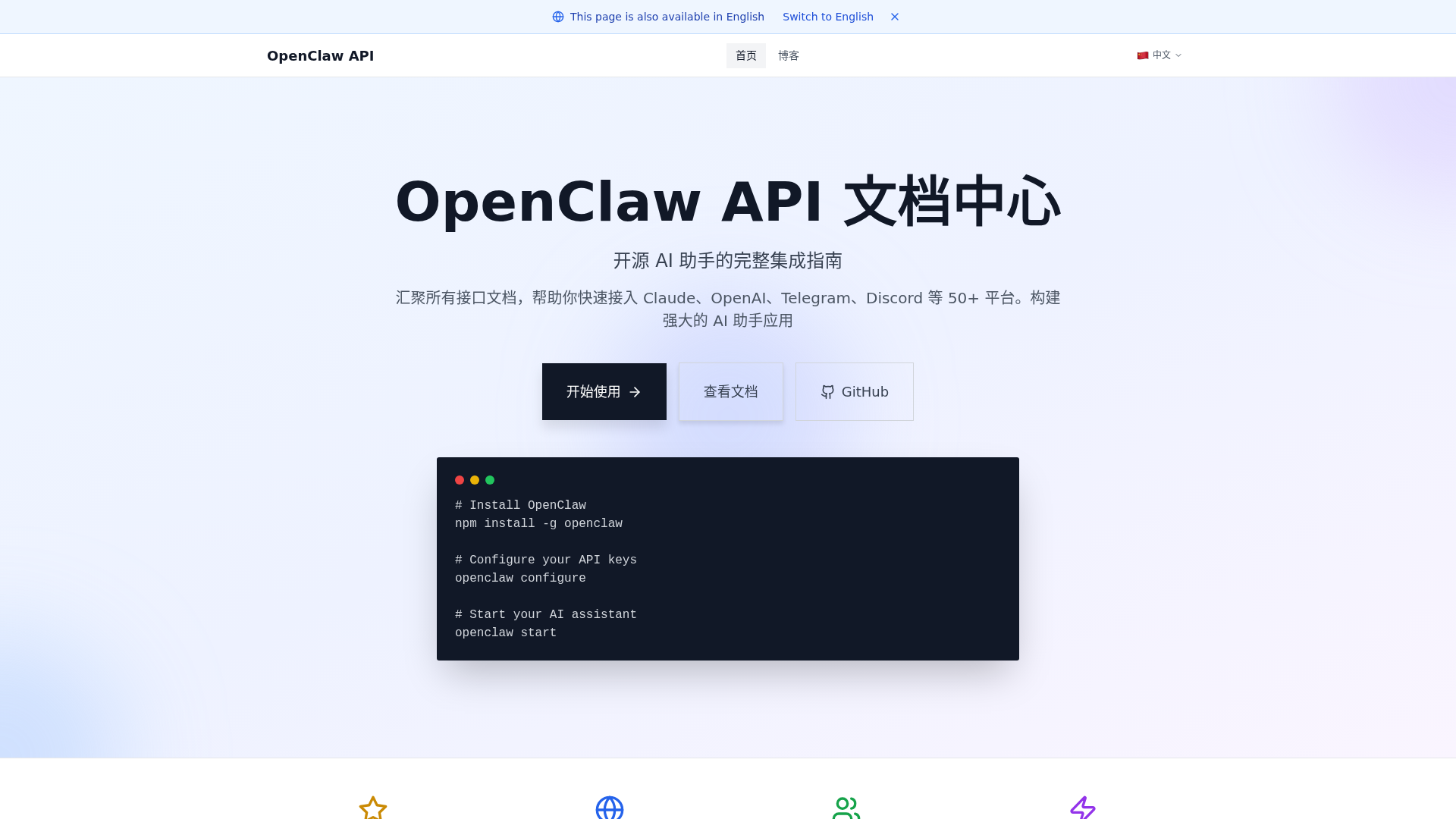
OpenClaw API is a comprehensive, open-source integration guide designed to empower developers in building powerful AI assistant applications. It consolidates interface documentation for over 50 platforms, including leading AI models like Claude and OpenAI, and communication channels such as Telegram and Discord. Its primary purpose is to simplify the integration of advanced AI capabilities into various applications, offering a robust and flexible framework for both personal and enterprise use.Key Features:Multi-model support for Anthropic Claude, OpenAI, Google Gemini, and local Ollama.Seamless integration with 20+ communication platforms like Telegram, Discord, Slack, and WhatsApp.Local-first architecture ensuring data control, private deployment, and Docker isolation.Advanced multimodal interaction capabilities, including voice calls and browser control.Extensible system with plugin-like skill extensions, supporting timed tasks and Webhooks.Completely open-source, community-driven, and continuously maintained.Use Cases:OpenClaw API is ideal for developers and teams looking to leverage AI across various scenarios. Individuals can create personalized AI assistants accessible via platforms like Telegram or WhatsApp, enhancing daily productivity and information access. For teams, it serves as a powerful collaboration tool, integrating AI into platforms like Slack or Discord to streamline communication, automate tasks, and improve overall efficiency.Furthermore, OpenClaw API facilitates the creation of sophisticated automated workflows. By utilizing its Webhooks and timed task interfaces, users can design intelligent systems that respond to events, process data, and execute actions across different services, transforming routine operations into smart, automated processes.Pricing Information:OpenClaw API is an entirely open-source project, making it free to use. It is community-driven, ensuring continuous updates and maintenance without any direct cost for its core functionalities.User Experience and Support:The platform emphasizes an "extremely simple" installation and configuration process, enabling users to build their first AI assistant in just three steps and five minutes. It provides a command-line tool for quick integration and offers comprehensive documentation, tutorials, and best practices through its blog. A dedicated FAQ section and technical support resources are available to address configuration and development queries, ensuring a smooth user experience.Technical Details:OpenClaw employs a modular architecture, utilizing a multi-model driven engine that supports native integration with major LLMs and leverages Function Calling for intelligent tool invocation. Its core features include a high-performance WebSocket-based distributed communication gateway for real-time synchronization and enterprise-grade security practices, such as mandatory environment variable or encrypted JSON5 configuration for sensitive credentials. The system also features a plugin-like skill extension mechanism following OpenAPI specifications.Pros:Extensive support for diverse AI models and communication platforms.Open-source and free, fostering community collaboration.Local-first architecture provides data privacy and control.High extensibility through plugin-like skills and Webhooks.Simplified installation and configuration process.Robust security practices for credential management.Cons:Community-driven support might vary in response time compared to commercial offerings.Advanced customization for complex AI agents may require deeper technical understanding.Reliance on external API keys for commercial AI models.Conclusion:OpenClaw API stands out as a versatile and powerful open-source solution for integrating AI into a multitude of applications and communication channels. Its focus on ease of use, extensive compatibility, and local data control makes it an excellent choice for developers aiming to build intelligent, secure, and scalable AI assistants. Explore OpenClaw API today to unlock the full potential of AI in your projects.

Arcadia Age API (A3): Frictionless US Age Compliance Arcadia Age API (A3) offers a unified, privacy-first age compliance solution for web, iOS, and Android applications. It provides compliant, frictionless age assurance built specifically for the US market, eliminating the need for verification walls, identity friction, or storing any Personally Identifiable Information (PII). This SaaS is ideal for fast-moving engineering and product teams in high-volume digital environments, including ad-supported mobile games, multi-platform communities, and e-commerce, where user experience and privacy are paramount. Key Features Frictionless Age Estimation: Uses passive behavioral signals for good-faith age estimation, preserving conversion rates without high-friction ID gates. Developer-First Integration: A self-serve, cross-platform SDK designed for integration and deployment in under 10 minutes, bypassing lengthy enterprise sales cycles. Built for Consumer Scale: Engineered for high-volume digital environments, ensuring robust performance and user experience. Zero PII, Zero Liability: No images, biometrics, or personal data are ever stored on servers, eliminating toxic data exposure and breach liability. Unified API, Every Platform: Normalizes Apple, Google, and browser age signals into a single response format with one audit trail. AB 1043 Compliance: Two-phase signal fusion directly maps to the statute, providing audit-ready verdicts, confidence scores, and cryptographic receipts. Use Cases Arcadia Age API (A3) empowers businesses to meet stringent state-level compliance mandates, such as AB 1043, without negatively impacting user acquisition or conversion metrics. By leveraging passive behavioral signals, A3 ensures that user funnels remain free of intrusive verification walls, allowing users to proceed seamlessly while the system estimates age in the background. Furthermore, A3 acts as an intelligent layer for anonymous web traffic, enabling confident serving of targeted ads to verified adults and routing estimated minors to compliant contextual ads. This capability protects ad revenue by maintaining impression volume while ensuring regulatory adherence, a critical advantage for ad-supported platforms. The solution eliminates the traditional trade-off between compliance and user experience, offering a superior alternative to methods like ID uploads or selfie scans. It provides a robust, privacy-centric approach to age assurance that is invisible to the end-user, ensuring a smooth and uninterrupted journey. Pricing Information Arcadia Age API operates on a paid model, with detailed pricing available upon request or through their "View Pricing" section. Users can obtain a free API key to begin integration and explore the platform's capabilities. User Experience and Support A3 is designed for a developer-first experience, offering a self-serve SDK that integrates in under 10 minutes. The user experience is frictionless and invisible to end-users, with sub-second processing times. Comprehensive documentation is available via "Read the Docs," and a "Playground" allows for hands-on testing. Direct support is also offered through scheduling a call with their team. Technical Details The platform utilizes passive signal fusion to estimate age, processing requests in under 200ms. It provides cross-platform coverage for iOS, Android, and Web, with a lightweight @a3api/signals SDK (<5KB) specifically for browser environments. A3 functions as a pass-through processor, ensuring no PII is stored on its servers. Pros and Cons Pros: Zero user friction and high conversion rates. Full compliance with US age mandates like AB 1043. No PII storage, eliminating data breach liability. Rapid integration (under 10 minutes). Unified API for all major platforms (Web, iOS, Android). Protects ad revenue by enabling compliant ad targeting. Cons: No specific cons are highlighted in the provided text. Conclusion Arcadia Age API (A3) delivers a powerful, privacy-centric solution for unified age compliance across web and mobile platforms. It enables businesses to meet regulatory demands without compromising user experience or conversion, all while safeguarding sensitive data. Explore A3 today to streamline your age assurance processes and ensure frictionless compliance.
routing.run is a robust SaaS platform designed to streamline AI model deployment and management for production teams. It provides a single, unified endpoint for routing requests across multiple AI model providers, ensuring reliability and efficiency. This solution is specifically tailored for production teams and developers who require stable, flexible, and cost-effective access to various large language models (LLMs) and AI services.Key Features:One Endpoint for Multiple Providers: Simplify integrations by connecting to various AI models through a single API, abstracting away provider-specific complexities.Fallback Chains and Live Routing Control: Dynamically manage model selection, set fallback orders, and adjust traffic policies in real-time to ensure continuous service and optimal performance.Predictable Request-Based Pricing: Offers clear, flat-rate pricing per request, making cost prediction easier and more stable than token-based billing.Smart Provider Failover: Automatically detects and reroutes traffic away from anomalous latency or outages to healthy fallback models in real-time.Zero Prompt Logging & No IP Tracking: Ensures complete data privacy and security by never logging user prompts, AI completions, IP addresses, or identifying metadata.Fully Open Source Infrastructure: Provides transparency and allows teams to inspect the routing code, fostering trust and enabling customization.Use Cases:routing.run is ideal for applications that depend on external AI models but need to mitigate the risks associated with provider volatility in quality, pricing, and uptime. For instance, a company building an AI-powered chatbot can use routing.run to seamlessly switch between different LLM providers (e.g., OpenAI, OpenRouter, Chutes) based on performance, cost, or availability without modifying their core application code. This ensures their service remains operational and optimized even if one provider experiences downtime or price changes, maintaining a consistent user experience.Another key use case involves managing costs and performance. By offering request-based pricing, routing.run allows businesses to predict their monthly spend more accurately, regardless of the context size of their AI prompts. This is particularly beneficial for applications with fluctuating or large context windows, where token-based pricing can lead to unpredictable and high bills. It also enables A/B testing of different models and providers to find the optimal balance of quality and cost, ensuring efficient resource allocation.Pricing Information:routing.run offers a flexible pricing model, including a free tier to get started with basic routing capabilities. For higher usage and advanced features, it provides predictable request-based pricing, which is a flat cost per request, making it easier to budget compared to token-based billing. Users can start for free and upgrade for higher limits, dedicated support, or custom routing infrastructure.User Experience and Support:The platform emphasizes ease of integration, stating that if an app already uses an OpenAI-compatible interface, users can often send their first request through routing.run in minutes, typically requiring only a base URL change and an API key. Comprehensive documentation is available to guide users through setup and configuration. For higher-tier plans, dedicated support is provided, ensuring that production teams receive timely assistance. The open-source nature of its infrastructure also contributes to user confidence and understanding, allowing for deeper inspection.Technical Details:routing.run functions as an intelligent proxy layer positioned between your application and various AI model providers. Its core routing infrastructure is fully open source, offering complete transparency into how requests are processed and routed. The system is engineered for real-time detection of anomalous latency and provider outages, enabling instant and automatic rerouting of traffic to healthy fallback models. Beyond external provider integration, routing.run also operates its own dedicated hardware for selected models and plans, providing an additional layer of stable capacity and optimized performance paths. The project is primarily built with Python and TypeScript, leveraging a Docker Compose stack with FastAPI, React, Weaviate, Neo4j, MongoDB, and Redis.Pros and Cons:Pros: Enhanced reliability and uptime through smart failover and dynamic fallback chains.Pros: Predictable cost management with flat-rate, request-based pricing.Pros: Strong privacy guarantees with zero prompt logging and no IP tracking.Pros: Flexibility to switch or combine AI providers without modifying client-side code.Pros: Transparency and trust due to fully open-source infrastructure.Cons: Requires initial setup and configuration for optimal performance.Cons: Effectiveness relies on proper configuration of fallback chains.Cons: Advanced features and dedicated support are reserved for paid plans.Conclusion:routing.run empowers AI production teams to build resilient, cost-effective, and privacy-conscious applications by abstracting away the complexities and volatilities of the AI model market. Its unique blend of dynamic routing, predictable pricing, and strong privacy features makes it an indispensable tool for modern AI development. Explore routing.run today to stabilize your AI integrations and gain unparalleled control over your model ecosystem.