Open source
Nodemailer is the most popular and widely used email sending library for Node.js, designed to make sending emails straightforward, secure, and efficient. It serves as a robust solution for developers looking to integrate email functionality into their Node.js applications without the hassle of managing complex dependencies. Targeted at Node.js developers and applications requiring reliable email delivery, Nodemailer simplifies the process of sending various types of emails, from transactional messages to rich HTML content with attachments. Key Features Zero Runtime Dependencies: Everything needed is included in a single, well-maintained package. Security Focused: Engineered to prevent remote code execution vulnerabilities. Full Unicode Support: Capable of sending messages with any characters, including emojis. Cross-Platform Compatibility: Works seamlessly across Linux, macOS, and Windows, ideal for cloud environments. Multiple Transports: Supports SMTP, Sendmail, Amazon SES, and stream-based sending. Advanced Authentication: Includes DKIM signing and OAuth2 authentication for enterprise-ready security. Use Cases Nodemailer is exceptionally versatile for various email-related tasks within Node.js applications. Developers can leverage it to send critical transactional emails such as user registration confirmations, password reset links, and order notifications, ensuring timely and secure communication with users. Its ability to handle both HTML and plain-text content, along with attachments and embedded images, makes it perfect for crafting rich, engaging emails. Beyond transactional emails, Nodemailer can be integrated into systems for sending automated reports, alerts, or even simple newsletters. For development and testing, its integration with Ethereal.email allows for instant generation of test accounts, providing a convenient sandbox to verify email sending functionality without hitting live mail servers. Furthermore, features like proxy support and DKIM/OAuth2 authentication make it suitable for applications operating in restricted network environments or requiring high levels of email authenticity and security. Pricing Information Nodemailer is open-source software, licensed under the MIT No Attribution (MIT-0) license. This means it is completely free to use in any project without attribution requirements, offering a cost-effective solution for email sending in Node.js applications. User Experience and Support Designed for ease of use, Nodemailer provides a straightforward API for creating transporters, composing messages, and sending emails. The library is well-documented, with clear examples and guides available to help developers get started quickly. As an open-source project, it benefits from community support and continuous maintenance by its creator, Andris Reinman, ensuring reliability and ongoing improvements. Technical Details Nodemailer requires Node.js v6.0.0 or later, with v8.0.0 or later recommended for examples utilizing async/await. It boasts zero additional system libraries, services, or build tools, making it lightweight and easy to integrate. The library supports various transport methods including standard SMTP, Amazon SES, and piping to local sendmail binaries, and offers a plugin API for extending functionality with custom transport methods. Pros and Cons Pros: Zero dependencies, highly secure, full Unicode support, cross-platform, flexible transport options, advanced authentication (DKIM, OAuth2), proxy support, excellent for testing with Ethereal.email. Cons: Requires Node.js development knowledge, not a full email marketing platform (it's a library), no built-in GUI for non-developers. Conclusion Nodemailer stands out as an indispensable library for any Node.js project requiring robust, secure, and easy-to-implement email sending capabilities. Its comprehensive feature set and developer-friendly approach make it the go-to choice for integrating email into your applications. Explore Nodemailer today to streamline your email workflows and enhance your application's communication features.

Zod is a powerful, TypeScript-first schema validation library designed to ensure data integrity and type safety across your applications. It allows developers to define robust schemas for validating data, ranging from simple primitives to complex, deeply nested objects, making it an essential tool for modern TypeScript development.It targets developers building applications with TypeScript who need reliable and type-safe data validation for APIs, forms, and general data processing.Key FeaturesZero external dependencies, ensuring a lightweight footprint.Works seamlessly in both Node.js environments and all modern browsers.Extremely tiny core bundle size, gzipped to just 2kb.Provides an immutable API, with methods returning new instances for predictable state management.Offers a concise and intuitive interface for defining schemas.Includes built-in conversion capabilities for JSON Schema.Boasts an extensive ecosystem of integrations and supporting libraries.Use CasesZod excels in scenarios where data validation is critical for application stability and security. Developers can use Zod to define the expected structure and types of incoming data from API endpoints, ensuring that only valid data is processed. This prevents common bugs and security vulnerabilities associated with malformed or unexpected input.Beyond API validation, Zod is widely adopted for form validation, particularly in frontend frameworks. Its integration with libraries like React Hook Form provides a seamless experience for building type-safe forms with robust client-side validation. It also serves as an excellent tool for validating configuration files, environment variables, or any internal data structures within a TypeScript project, guaranteeing consistency and correctness.Pricing InformationZod is an open-source library, making it freely available for use in any project. While there are no direct pricing tiers for the library itself, it encourages sponsorship at various levels to support its ongoing development and maintenance.User Experience and SupportDesigned with a "TypeScript-first" philosophy, Zod offers an excellent developer experience with static type inference that guides you as you define schemas. Its concise API makes schema definition straightforward, even for complex data structures. Comprehensive documentation is available, and community support can be found through its Discord channel, fostering a collaborative environment for users.Technical DetailsZod is built for TypeScript environments, officially supporting TypeScript v5.5 and later. It operates without any external dependencies, contributing to its small bundle size and high performance. The library is compatible with both Node.js runtimes and modern web browsers, offering broad applicability across different project types.Pros and ConsPros:TypeScript-first with powerful static type inference.Extremely lightweight with zero external dependencies.Highly performant and works universally across environments.Immutable API promotes predictable code.Extensive ecosystem and community support.Built-in JSON Schema conversion.Cons:Requires TypeScript v5.5+ for full official support.While concise, complex schemas might have a slight learning curve for newcomers.ConclusionZod stands out as a premier TypeScript-first validation library, offering an unparalleled combination of type safety, performance, and developer experience. Its ability to define and validate data schemas with static type inference makes it an indispensable tool for building robust and reliable applications. Explore Zod today to elevate your data validation strategy and enhance your TypeScript projects.
Docusaurus is an open-source static site generator designed to help developers and teams quickly build optimized documentation websites, blogs, and marketing pages. It empowers users to focus on content creation by leveraging modern web technologies and a pluggable architecture.Targeted at open-source projects, engineering teams, and anyone needing robust, versioned, and localized content sites, Docusaurus streamlines the process of publishing high-quality web content.Key Features Powered by MDX: Write documentation and blog posts using Markdown with embedded React components for rich, interactive content. Built Using React: Extend and customize your site's layout and functionality with familiar React components. Ready for Translations: Out-of-the-box localization support, compatible with Git, Crowdin, and other translation managers. Document Versioning: Maintain multiple versions of your documentation, keeping it in sync with project releases. Content Search: Integrated search functionality, proudly supporting Algolia for efficient content discovery. Pluggable Architecture: Design and customize your site while reusing data created by Docusaurus plugins.Use CasesDocusaurus is ideal for open-source projects like Redux, React Native, and Temporal, where maintaining comprehensive and up-to-date documentation is crucial. It allows project maintainers to easily manage content, support multiple versions, and provide localized experiences to a global audience. Companies like Supabase also leverage Docusaurus to build and maintain their product documentation efficiently, reducing the time spent on infrastructure and focusing on delivering valuable content.Beyond documentation, Docusaurus serves as an excellent tool for creating content-focused websites, personal blogs, and marketing pages. Its ability to embed React components within Markdown makes it versatile for interactive tutorials and dynamic content, while features like versioning and localization ensure scalability and reach for any content-driven initiative.Pricing InformationDocusaurus is an open-source project, making it free to use. While there's no direct pricing model, the community and project maintainers are supported through sponsorships, as highlighted by Temporal's contribution.User Experience and SupportUsers consistently praise Docusaurus for its ease of setup and use, allowing them to "focus on content" rather than complex configurations. Its intuitive approach makes it "simple to setup" and "friendly for new contributors." The project boasts a strong community with support available via Stack Overflow, Discord, and GitHub, ensuring users can find help and contribute to its ongoing development.Technical DetailsBuilt upon React, Docusaurus processes MDX files to generate static HTML, CSS, and JavaScript. This approach ensures optimized performance and easy deployment. Its pluggable architecture allows for deep customization and integration with various tools and services, making it a flexible choice for modern web development.Pros and Cons Pros: Optimized static site generation, MDX support for rich content, React extensibility, built-in localization and versioning, integrated search, strong community, easy to set up and maintain, ideal for documentation and content sites. Cons: Requires familiarity with React for advanced customization, primarily focused on static content generation (less suitable for highly dynamic, server-rendered applications without additional tooling).ConclusionDocusaurus stands out as a robust and developer-friendly solution for building and maintaining high-quality, content-focused websites. Its blend of modern web technologies, powerful features, and an active community makes it an excellent choice for anyone looking to create efficient, scalable, and well-documented online presences. Explore Docusaurus today to streamline your content delivery!
Tremor is an open-source React component library designed to empower developers to build beautiful, accessible, and production-ready dashboards and analytical interfaces with speed and efficiency. It serves as a comprehensive toolkit for creating data-rich applications, allowing teams to focus on insights rather than intricate UI design. Key Features 35+ fully open-source, accessible components for dashboards and charts. Built with React, Tailwind CSS, and Radix UI for modern web development. Beautiful defaults and simple props for easy customization and pixel-perfect design. Modular input components for advanced filtering, including Date Pickers, Range Sliders, and Multi-Logic Filters. Advanced visualizations like Tracker, Bar Lists, Data Bars, Spark Charts, and Progress Circles for complex data representation. Over 250 blocks and templates, including pre-defined dashboards and analytical interfaces, to accelerate project kick-off. Use Cases Tremor is ideal for developers and product teams looking to integrate sophisticated data visualization into their web applications. It excels in scenarios requiring the creation of internal analytics dashboards, customer-facing data portals, or any application where data needs to be presented clearly and interactively. By providing a robust set of components and templates, Tremor significantly reduces the development time and effort typically associated with building complex analytical UIs. Furthermore, Tremor can be leveraged to build entire SaaS marketing websites, report pages, and full-fledged data applications. Its production-ready templates, crafted with React and Next.js, offer a head start for launching new ideas, ensuring a consistent and high-quality user experience from the outset. It solves the common problem of needing to design and build custom UI components for data display, allowing teams to deliver value faster. Pricing Information Tremor operates on a freemium model, offering a core set of 35+ fully open-source components for free. Additionally, it provides access to "Premium Blocks" and "Tremor Templates" which likely offer more advanced or pre-built solutions, catering to various project needs and budgets. Specific pricing tiers for premium offerings are not detailed in the provided content. User Experience and Support The library emphasizes a smooth user experience with "beautiful defaults" and "simple props," enabling developers to customize components quickly and spend less time on design. Its "accessible by design" philosophy, built on Radix UI, ensures that the resulting interfaces are inclusive. Tremor offers comprehensive "Docs" and a "Changelog" for developers, alongside "Contact us" options for support. Getting started is made easy with both copy-and-paste options for individual components and an NPM package for quick integration. Technical Details Tremor is primarily built for the React ecosystem, leveraging the popular Tailwind CSS framework for styling and Radix UI for accessibility primitives. Its chart components are built on Recharts. For its extensive collection of blocks and templates, it utilizes React and Next.js, making it a powerful choice for modern web applications. Pros and Cons Pros: Open-source and accessible; significantly speeds up dashboard development; beautiful, customizable defaults; extensive component and template library; strong community backing; built with modern, popular technologies (React, Tailwind, Radix UI); supports complex data filtering and visualization. Cons: Primarily focused on React/Next.js ecosystem, which might be a limitation for non-React projects; "Premium Blocks" imply potential costs for advanced features; while simple props are highlighted, extensive customization might still have a learning curve. Conclusion Tremor stands out as an invaluable resource for developers aiming to create sophisticated, data-driven web applications with efficiency and elegance. Its blend of open-source components, production-ready templates, and a focus on accessibility makes it a compelling choice for any project requiring robust data visualization. Explore Tremor today to transform your data into compelling visual stories.
Convex is a powerful backend-as-a-service (BaaS) that provides developers with the essential building blocks to create real-time, full-stack applications. It allows expressing the entire backend, from database schemas to APIs and authentication, in pure TypeScript, offering a seamless and type-safe development experience. Convex targets developers and startups looking to build and scale their applications with confidence, simplifying complex backend infrastructure.Key Features:Everything is Code: Define database schemas, queries, auth, and APIs entirely in TypeScript, living alongside your app code with type-checking and autocompletion.Always in Sync: Guarantees real-time updates across frontend, backend, and database state, eliminating the need for state managers, cache invalidation, or websockets.AI Coding: Leverage AI to generate high-quality Convex code, enhancing developer productivity.Backend Built-ins: Includes features like cron jobs, backend AI workflows, built-in authentication (80+ OAuth integrations), and a growing ecosystem of modular components.Open Source: Self-host and develop locally, with support for open-source projects.Strong Consistency & ACID Database: Provides a reliable and robust data store with vector search capabilities.Use Cases:Convex is ideal for developers aiming to build modern, real-time web applications without the overhead of managing complex backend infrastructure. It simplifies the creation of interactive user interfaces where data needs to be instantly reflected across clients, such as collaborative tools, chat applications, or live dashboards. For instance, a developer can quickly build a full-stack todo application with real-time updates, AI categorization, and robust authentication using Convex's TypeScript-first approach. It also serves as a powerful platform for building AI agents, providing the necessary backend components to manage data and workflows. Startups can leverage Convex to rapidly prototype and scale their products, benefiting from its integrated features and end-to-end type safety, which significantly reduces development time and potential bugs.Pricing Information:While specific pricing tiers are not detailed in the provided content, Convex offers a "Pricing" section on its website, suggesting a structured pricing model. Given its nature as a developer tool, it likely includes a freemium option or a free trial to allow developers to get started and explore its capabilities before committing to a paid plan.User Experience and Support:Convex is praised by developers for its exceptional developer experience (DX), often described as "magical" and "simple, fast, realtime." It provides comprehensive documentation, quickstart guides for popular frameworks like React, Next.js, and Vue, and a vibrant community Discord for sharing ideas and asking for help. The platform emphasizes ease of use, with many users highlighting its ability to simplify complex tasks like state management and real-time updates.Technical Details:Convex is built around a TypeScript-first philosophy, allowing developers to define their entire backend logic, database schemas, and API endpoints using TypeScript. It integrates seamlessly with modern frontend frameworks such as React, Next.js, Vue, Svelte, and even Python and Rust. Under the hood, it provides an ACID-compliant document database with vector search capabilities, serverless functions, and real-time synchronization mechanisms, abstracting away the complexities of websockets and state management.Pros and Cons:Pros:End-to-end type safety and autocompletion with TypeScript.Built-in real-time updates without manual setup.AI code generation for increased productivity.Simplified backend development, replacing multiple services (DB, auth, APIs, cron).Strong community and excellent developer experience.Open-source components and self-hosting options.Cons:Primarily focused on the TypeScript/JavaScript ecosystem.Adopting a new paradigm might have a learning curve for some developers.Specific pricing details are not immediately available in the provided text.Reliance on a single vendor for core backend services.Conclusion:Convex offers a compelling solution for developers seeking to streamline backend development and build real-time applications with unparalleled ease and type safety. By unifying the backend into a TypeScript codebase, it significantly reduces complexity and accelerates development cycles. Explore Convex today to transform your application development workflow and build with confidence.
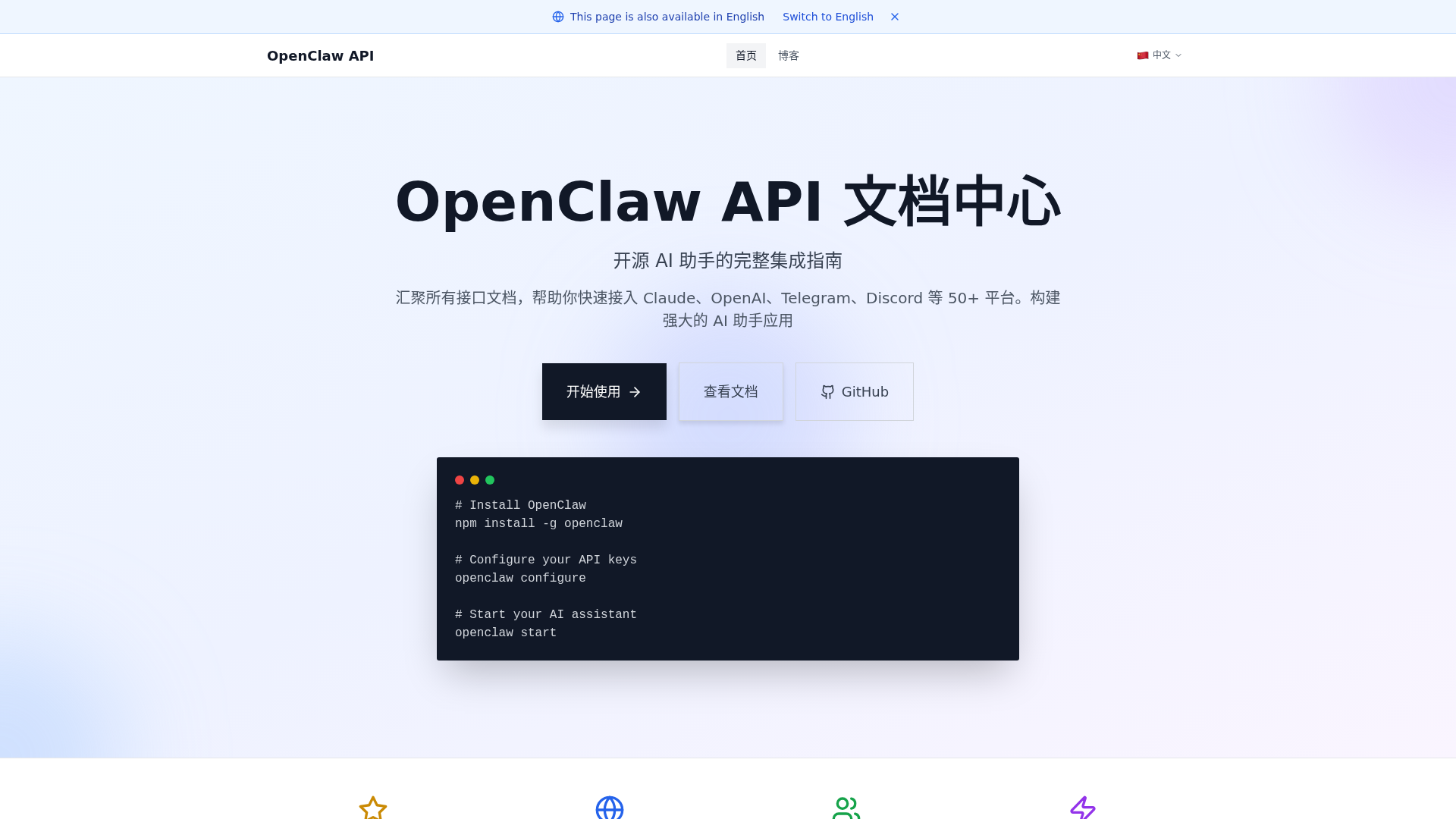
OpenClaw API is a comprehensive, open-source integration guide designed to empower developers in building powerful AI assistant applications. It consolidates interface documentation for over 50 platforms, including leading AI models like Claude and OpenAI, and communication channels such as Telegram and Discord. Its primary purpose is to simplify the integration of advanced AI capabilities into various applications, offering a robust and flexible framework for both personal and enterprise use.Key Features:Multi-model support for Anthropic Claude, OpenAI, Google Gemini, and local Ollama.Seamless integration with 20+ communication platforms like Telegram, Discord, Slack, and WhatsApp.Local-first architecture ensuring data control, private deployment, and Docker isolation.Advanced multimodal interaction capabilities, including voice calls and browser control.Extensible system with plugin-like skill extensions, supporting timed tasks and Webhooks.Completely open-source, community-driven, and continuously maintained.Use Cases:OpenClaw API is ideal for developers and teams looking to leverage AI across various scenarios. Individuals can create personalized AI assistants accessible via platforms like Telegram or WhatsApp, enhancing daily productivity and information access. For teams, it serves as a powerful collaboration tool, integrating AI into platforms like Slack or Discord to streamline communication, automate tasks, and improve overall efficiency.Furthermore, OpenClaw API facilitates the creation of sophisticated automated workflows. By utilizing its Webhooks and timed task interfaces, users can design intelligent systems that respond to events, process data, and execute actions across different services, transforming routine operations into smart, automated processes.Pricing Information:OpenClaw API is an entirely open-source project, making it free to use. It is community-driven, ensuring continuous updates and maintenance without any direct cost for its core functionalities.User Experience and Support:The platform emphasizes an "extremely simple" installation and configuration process, enabling users to build their first AI assistant in just three steps and five minutes. It provides a command-line tool for quick integration and offers comprehensive documentation, tutorials, and best practices through its blog. A dedicated FAQ section and technical support resources are available to address configuration and development queries, ensuring a smooth user experience.Technical Details:OpenClaw employs a modular architecture, utilizing a multi-model driven engine that supports native integration with major LLMs and leverages Function Calling for intelligent tool invocation. Its core features include a high-performance WebSocket-based distributed communication gateway for real-time synchronization and enterprise-grade security practices, such as mandatory environment variable or encrypted JSON5 configuration for sensitive credentials. The system also features a plugin-like skill extension mechanism following OpenAPI specifications.Pros:Extensive support for diverse AI models and communication platforms.Open-source and free, fostering community collaboration.Local-first architecture provides data privacy and control.High extensibility through plugin-like skills and Webhooks.Simplified installation and configuration process.Robust security practices for credential management.Cons:Community-driven support might vary in response time compared to commercial offerings.Advanced customization for complex AI agents may require deeper technical understanding.Reliance on external API keys for commercial AI models.Conclusion:OpenClaw API stands out as a versatile and powerful open-source solution for integrating AI into a multitude of applications and communication channels. Its focus on ease of use, extensive compatibility, and local data control makes it an excellent choice for developers aiming to build intelligent, secure, and scalable AI assistants. Explore OpenClaw API today to unlock the full potential of AI in your projects.