Security

WebAgentScan is a hosted SaaS platform designed to comprehensively score any website for its AI agent readiness, MCP server security, and Domain Rating. It provides a single score out of 100 across seven critical graded areas, offering businesses and developers a clear understanding of their site's visibility and security posture in the age of AI. The primary target audience includes website owners, digital marketers, SEO specialists, and web developers who want to ensure their online presence is optimized for AI assistants like ChatGPT, Claude, Perplexity, and Google AI, as well as maintain robust server security. Key Features Scores any domain out of 100 across seven graded areas, including AI agent readiness and security. Evaluates discovery files such as llms.txt, agents.txt, agent cards, and all .well-known paths. Assesses machine content negotiation, structured data implementation, and no-JavaScript survival. Analyzes agent access controls, identifying which crawlers are admitted and detecting soft 404s. Grades MCP server quality, including JSON-RPC capabilities and advertised tools. Examines agent security, covering authentication posture, exposed files, and prompt injection surface. Provides Domain Rating (DR), referring domains, and backlinks data from licensed APIs. Generates a prioritized fix list, detailing the actual value of each recommended improvement. Use Cases WebAgentScan is invaluable for businesses aiming to enhance their visibility in AI-driven search results. By ensuring their website is properly indexed and understood by AI agents, companies can significantly increase their chances of being quoted by AI assistants, potentially leading to higher conversion rates. It helps developers and SEO professionals identify and rectify technical issues hindering AI indexing and search performance, streamlining optimization efforts. The platform also serves as a critical tool for assessing and bolstering website security, particularly concerning MCP servers and prompt injection vulnerabilities, ensuring sites are both discoverable and resilient against malicious AI interactions. Pricing Information WebAgentScan operates on a subscription-based model with plans starting from $9 per month. There is no free tier or trial period available. Plans include Starter ($9/mo), Pro ($29/mo), and Proprietary ($100/mo), each offering different allowances for scans and DR lookups, with capped seat limits. Payments are processed directly on the scanner platform, and subscriptions can be canceled at any time. User Experience and Support As a hosted SaaS, WebAgentScan is designed for ease of access. While specific details on the user interface or dedicated support channels are not explicitly provided, the "cancel anytime" policy suggests a straightforward, self-service approach. The platform's output includes a clear score and a fix list, implying an intuitive presentation of complex data for actionable insights. Technical Details The SaaS leverages advanced scanning capabilities to evaluate websites against specific criteria for AI agent interaction. It assesses MCP server quality by speaking JSON-RPC and integrates with licensed APIs to provide accurate Domain Rating, referring domains, and backlink data. The system is designed to identify and interpret various discovery files and content negotiation strategies relevant to modern AI crawlers. Pros and Cons Pros: Comprehensive scoring for AI agent readiness, security, and SEO; Detailed, prioritized fix list; Transparent pricing with clear allowances; Direct payment on scanner for enhanced security. Cons: No free tier or trial available; Capped seat limits on all plans; Additional billing for usage exceeding plan allowances; Specific UI/UX details and dedicated support channels are not explicitly outlined. Conclusion WebAgentScan is an essential tool for any business or individual looking to optimize their website for the evolving landscape of AI search and ensure robust security. Its detailed scoring and actionable insights provide a clear roadmap to improved AI visibility and domain authority. Scan your site today to unlock its full potential in the AI-driven web.

CarrotVPN: Free, Fast, and Secure WireGuard® VPN for AndroidCarrotVPN is a cutting-edge, 100% free VPN service designed specifically for Android users, leveraging the advanced WireGuard® protocol to deliver unparalleled speed and security. It empowers individuals to protect their online privacy and access the internet without restrictions, all through an intuitive, one-tap interface.This service is ideal for any Android user concerned about their digital footprint, seeking to secure their connection on public Wi-Fi, or wishing to bypass geo-restrictions for streaming and gaming.Key Features100% Free to Use: Enjoy full VPN functionality without any hidden costs or mandatory subscriptions.WireGuard® Encryption: Utilizes the modern, open-source, and independently audited WireGuard® protocol for superior security and performance.Strict No-Logs Policy: CarrotVPN guarantees that it never tracks, stores, or sells your browsing data, ensuring complete anonymity.Blazing Fast Speed: Optimized server infrastructure minimizes speed loss, perfect for 4K streaming, online gaming, and seamless browsing.Global Servers: Connect to strategically located high-speed servers across the world, including the USA, Germany, France, Singapore, and Bangladesh.Kill Switch: Automatically blocks all network traffic if the VPN connection drops, preventing your real IP from being exposed.DNS Leak Protection: Routes all DNS queries through a secure, encrypted tunnel to protect your browsing history from ISPs and attackers.Split Tunneling: Offers granular control by allowing users to choose which apps route through the VPN and which use a regular connection.Use CasesCarrotVPN excels in scenarios where online privacy and unrestricted access are paramount. For individuals frequently connecting to public Wi-Fi networks in cafes, airports, or hotels, CarrotVPN provides an essential layer of security, encrypting all data and safeguarding against potential hackers and data snoopers. This ensures that sensitive information, including online banking details, remains protected.Beyond security, CarrotVPN is a powerful tool for entertainment and productivity. Users can effortlessly access geo-restricted content from their favorite streaming platforms, unlocking a world of movies, TV shows, and sports regardless of their physical location. Gamers benefit from reduced DDoS attack risks, the ability to bypass region locks, and access to global game servers, leading to a smoother and more expansive gaming experience.Pricing InformationCarrotVPN is 100% free to download and use. The service is supported by advertisements within the app, which help fund ongoing development and server maintenance. There are no hidden charges, premium tiers, or mandatory subscriptions, making it an accessible solution for everyone.User Experience and SupportDesigned for simplicity, CarrotVPN offers a clean, modern interface that requires no technical knowledge. Its one-tap connection feature allows users to instantly secure their internet traffic by simply pressing a shield button. The app also provides real-time statistics, including live download/upload speeds and total data usage, for full transparency. For support, users can contact the dedicated team via email at support@vinnorokom.com or contact@vinnorokom.com, with a commitment to respond within 24 hours.Technical DetailsAt its core, CarrotVPN is powered by the WireGuard® protocol, a modern, open-source, and independently audited VPN technology renowned for its efficiency, speed, and robust security. This protocol significantly outperforms older VPN technologies like OpenVPN and IPSec in terms of performance and battery consumption. The app requires Android 5.0 (API level 21) or higher to operate, and certain advanced features like the Kill Switch may necessitate device administrator permissions for full functionality.Pros and ConsPros:Completely free with no hidden costs.Utilizes the fast and secure WireGuard® protocol.Strict no-logs policy ensures user privacy.Easy-to-use, one-tap connection interface.Includes essential security features like Kill Switch and DNS Leak Protection.Offers Split Tunneling for flexible traffic management.Global server network for diverse access.Cons:Currently available only for Android devices.App may contain ads to support development.Initial server locations are somewhat limited, though more are promised.ConclusionCarrotVPN stands out as a highly effective, free, and user-friendly VPN solution for Android users. By integrating the cutting-edge WireGuard® protocol with a strict no-logs policy and essential security features, it provides a robust shield for online privacy and freedom. For anyone seeking a reliable and fast VPN experience without the cost, CarrotVPN is an excellent choice to explore.

Cutline by VibeKiln is a cutting-edge SaaS platform designed to optimize product discoverability and build trust in the AI era. It helps product teams, developers, and AI agents understand, trust, and safely use products by providing a comprehensive evidence trail from intent to implementation. Its primary purpose is to ensure that AI-built products are not only functional but also secure, reliable, and compliant, addressing the unique challenges of developing with AI. Targeted at developers, product managers, and organizations leveraging AI for product development, Cutline ensures that products are well-understood by both human users and AI systems, preventing common pitfalls like security vulnerabilities and architectural rework. Key Features AI Discoverability & Product UX: Ensures products can be found, understood, and cited by answer engines and AI systems, improving indexing and retrievability. Trust Pipeline for the AI Era: Verifies if a product can be found, believed, compared fairly against competitors, and safely used, creating citable proof surfaces. Engineering Risk Scan: Scans code for critical security, reliability, and scalability risks early in the development cycle, even for AI-generated changes. Agent-Ready Constraints: Translates product intent into structured, actionable constraints that can be directly fed to MCP-compatible coding agents and IDEs. Governance Trust & Compliance: Automatically detects tech stacks (e.g., Stripe, FHIR, OpenAI) to inject framework-specific compliance constraints (SOC 2, PCI-DSS, HIPAA, OWASP LLM Top 10) into the agent's context. Trusted Intent & Changes: Acts as an "Intent-to-Constraint Engine" and "Dependency Logic Guardrail" to ensure agents build the right thing and respect existing architectural decisions. Use Cases Cutline addresses critical pain points in modern software development, especially with the rise of AI-powered coding. For instance, it prevents scenarios where AI agents blindly accept prompts without considering security or scalability, saving teams from costly architectural rework and late-stage bug discovery. Developers tired of "ChatGPT saying 'You're Absolutely Right!!!' to everything" will find Cutline invaluable for injecting real-world constraints and guardrails into their AI's context. It also helps product teams avoid building features that lack market validation or clear technical requirements, as highlighted by satirical quotes like "Cutline told me NOT to build 47 of my features. Ignored them all. My app has 3 users now (all bots)." By validating intent and surfacing assumptions early, Cutline ensures that development efforts are aligned with actual product needs and technical feasibility. Furthermore, it ensures that products are not just functional but also compliant with industry standards and regulations, automatically loading relevant governance constraints based on the project's tech stack. Pricing Information Cutline operates on a freemium model. Users can access a free preliminary score for product discoverability and run free security vibe checks on their code. A paid audit provides detailed explanations, competitive analysis, and specific recommendations. Premium features include a product-specific constraint graph, RGR remediation plans, pre-mortem analysis, and persona feedback. User Experience and Support Cutline is designed for developers, integrating directly into AI coding tools and IDEs like Cursor, Claude Code, and Windsurf via the Model Context Protocol (MCP). Installation is straightforward using npm, and free security vibe checks require no account. The platform focuses on providing structured context and guardrails to agents, making the development process more robust. While the content implies a developer-centric interface, the emphasis is on seamless integration into existing workflows rather than a separate complex UI. Technical Details Cutline leverages the Model Context Protocol (MCP) to inject source-backed security, scalability, and reliability constraints directly into coding agents' context windows. It uses npm for installation and integrates with various AI code editors and no-code app builders. The system intelligently detects tech stacks (e.g., Stripe, FHIR, OpenAI) to dynamically load relevant compliance frameworks like PCI-DSS, HIPAA, and OWASP LLM Top 10, ensuring context-aware governance. Pros and Cons Pros: Enhances AI discoverability and product trust for the AI era. Proactively identifies security, reliability, and scalability risks. Provides concrete, agent-ready implementation constraints. Automates compliance and governance based on tech stack. Shifts left critical quality and security checks into the build process. Prevents architectural rework and building misaligned features. Cons: Currently in early access, implying potential for evolving features. Primarily targets developers and AI-driven development, potentially a learning curve for others. Requires integration with MCP-compatible coding agents and IDEs. The full value is unlocked with premium features and deeper integration. Conclusion Cutline by VibeKiln offers a robust "Confidence Infrastructure for AI-Built Products," ensuring that products are not only technically sound but also trustworthy and compliant from conception to deployment. By bridging the gap between product intent, engineering rigor, and AI agent execution, it creates a consistent and reliable product story for humans, answer engines, and coding agents alike. Explore Cutline today to validate your product ideas, scan your code for risks, and harden your AI development context.

IntroductionSecVibe offers a groundbreaking SaaS solution designed to secure applications developed with AI assistance. It integrates seamlessly with existing security infrastructure, providing specialized controls to address the unique vulnerabilities inherent in AI-generated code. This platform is essential for modern development teams leveraging AI coding assistants.SecVibe targets development teams, security professionals, and organizations that utilize AI tools for code generation and want to ensure the integrity and security of their AI-assisted applications.Key FeaturesSpecialized AI Code Detection: Identifies security patterns unique to AI-generated code, often missed by traditional security tools.Real-Time Vulnerability Analysis: Continuously monitors code as it's being written with AI, catching issues proactively.Context-Aware Security Controls: Adapts protection mechanisms based on application nature, user types, and exposure levels for precise defense.Intelligent Security Insights: Provides tailored analytics to track security posture and trends for AI-developed applications.Zero Friction Integration: Enhances security without impeding the speed and agility of AI-driven development workflows.Complementary Security Layer: Works alongside existing SAST, SCA, and DAST tools to offer a comprehensive security solution.Use CasesSecVibe is invaluable for organizations adopting AI coding assistants to accelerate development. For instance, a fintech company using AI to generate backend API code can leverage SecVibe to automatically detect subtle security flaws introduced by the AI that might bypass standard static analysis, such as insecure data handling patterns or misconfigurations specific to AI-generated logic. This ensures compliance and protects sensitive financial data from the outset.Another scenario involves a fast-paced startup building a new web application with AI-assisted front-end and backend components. SecVibe's real-time analysis and context-aware controls would allow their developers to identify and remediate potential vulnerabilities as they code, preventing costly security breaches in production. It helps maintain development velocity while upholding high security standards, crucial for rapid iteration and deployment.Pricing InformationSecVibe operates on a subscription-based model. While specific pricing tiers are not detailed, it is designed to offer flexible plans suitable for various team sizes and organizational needs. Interested users are encouraged to inquire about subscription options.User Experience and SupportDesigned for "Zero Friction," SecVibe aims to integrate smoothly into existing development workflows, ensuring security enhancements do not slow down fast-moving teams. The platform is built to be intuitive, allowing developers and security teams to quickly adopt and leverage its advanced capabilities. Although specific documentation or support channels are not mentioned, the emphasis on ease of use suggests a user-friendly interface and accessible resources.Technical DetailsSecVibe is engineered to address the complexities of AI-generated code, implying the use of advanced machine learning and pattern recognition algorithms for specialized detection. While specific programming languages or frameworks are not disclosed, its focus on "AI-assisted development" suggests compatibility with a wide range of modern coding environments and AI tools. It functions as a complementary layer to traditional SAST, SCA, and DAST solutions.Pros and ConsPros:Specialized detection for AI-generated code, filling a critical gap.Real-time analysis prevents vulnerabilities from reaching production.Context-aware controls offer highly tailored and effective protection.Seamless integration with existing security stacks.Designed for high-velocity AI-driven development without friction.Continuously evolves with AI coding advancements.Cons:Specific pricing details are not publicly available.No explicit mention of supported programming languages or frameworks.Requires integration with an existing security stack, not a standalone solution.New technology, so long-term efficacy and community support are yet to be fully established.Potential learning curve for understanding AI-specific security patterns.ConclusionSecVibe provides an essential, forward-thinking security solution for the rapidly evolving landscape of AI-assisted software development. By offering specialized controls and real-time analysis for AI-generated code, it empowers teams to build secure applications at speed. Explore SecVibe to future-proof your AI-powered development workflows and enhance your security posture.

IntroductionSafetyDocs is a SaaS platform designed to revolutionize how event teams manage safety documentation. It replaces static, outdated paper files and PDFs with live, mobile-ready safety documents, ensuring improved communication, compliance, and on-site decision-making. Its primary purpose is to centralize and synchronize critical safety information for event organizers and their teams.Target AudienceThe platform caters to a wide range of event organizers, from those managing small gatherings like weddings and fairs to large-scale corporate events and those requiring compliance with regulations like Martyn's Law. It's ideal for any event team looking to streamline safety processes, reduce administrative burden, and enhance real-time incident response.Key FeaturesLive-Syncing Mobile Access: Provides real-time access to safety files on mobile devices, even offline, ensuring teams always have the correct version.Master Data Synchronization: Centralizes key information in a master document, automatically populating updates across all related safety plans and risk assessments.Extensive Template Library: Offers over 65 Risk Assessment Templates and 13 essential documents for a comprehensive event safety file.Dedicated Domain & Hosting: Large organizations can benefit from a branded, dedicated domain with complete admin control and unlimited users.Mobile App (iOS & Android): Facilitates instant access, real-time updates, and on-site risk assessments for team members.Easy Document Creation & Editing: Allows users to upload existing documents for editing or create new ones, with easy deployment.Use CasesSafetyDocs is invaluable for event organizers who are tired of the inefficiencies and risks associated with traditional document management. It solves common problems like version control issues (e.g., "Final_V2.pdf"), the manual and error-prone process of updating information across multiple documents, and the lack of clear access control in generic file-sharing platforms like Dropbox or Google Drive. In an emergency, the platform provides quick, searchable access with live hyperlinks and emergency contact buttons, which is crucial for rapid response.For events requiring strict compliance, such as those falling under Martyn's Law for 800+ attendees, SafetyDocs simplifies the process of documenting protective measures, assessing vulnerabilities, and ensuring readiness for regulatory reviews. It helps teams maintain a professional image in front of authorities by demonstrating proactive and organized safety planning.Pricing InformationSafetyDocs offers a flexible pricing structure, including a 14-day free trial with no credit card required. Individual users can access a free demo account or opt for "Portal Access" at £6.99 per month to create and download their own documents. For specific events, the "Single Event" plan is available for £249, offering unlimited users and full template access. Larger organizations can inquire about "Corporate" solutions, which provide a tailored, branded platform with custom templates and full support.User Experience and SupportThe platform emphasizes ease of use, allowing for easy editing and deployment of documents via its mobile app. Users benefit from help guides, support documentation, and a ticket system for assistance. Dedicated support hours are available Monday-Friday (8 AM-6 PM) and Saturday-Sunday (9 AM-5 PM). The mobile app is designed to keep teams in sync with live updates and instant access to critical information, even offline.Technical DetailsSafetyDocs operates on secure, cloud-based servers, incorporating security features like username/password authentication and 2FA. Admin rights allow for granular control over user access, ensuring only invited users can view sensitive information. The platform is regularly tested against brute force attacks by external organizations, highlighting its commitment to data security. While specific programming languages are not mentioned, its cloud-based nature and mobile app integration suggest a robust web and mobile development stack.Pros and ConsPros:Eliminates version control issues with live-syncing documents.Significantly reduces administrative time and errors.Enhances compliance with safety regulations and legal requirements (e.g., Martyn's Law).Provides instant, mobile access to critical safety information, even offline.Offers a comprehensive library of risk assessment templates.Improves on-site decision-making and incident response.Secure, cloud-based platform with robust access controls.Cons:Requires initial effort to upload and adapt existing documents.Disclaimer notes it's not a substitute for a full risk assessment, requiring user diligence.Corporate pricing is "POA" (Price on Application), which might require direct contact for larger organizations.ConclusionSafetyDocs empowers event teams to move beyond outdated, static safety documentation, offering a dynamic, compliant, and efficient solution for managing event safety. By centralizing information, ensuring real-time access, and streamlining updates, it helps organizations stay confident, compliant, and in control. Explore SafetyDocs today to transform your event safety planning and ensure everyone goes home safe.
ExamJungle is a leading online platform providing premium practice tests and an advanced exam simulator designed to help IT professionals and aspiring candidates confidently pass their certification exams. Its primary purpose is to offer a realistic and comprehensive study experience for a wide array of industry-recognized certifications. The platform targets individuals pursuing certifications from major IT vendors such as CompTIA, Microsoft, Amazon, Google, Salesforce, HP, Oracle, Cisco, and VMware, making it an essential tool for career advancement and skill validation in the technology sector. Key Features: Realistic Exam Simulator: Practice in a timed environment that mirrors the real exam experience, including question types, scoring, and pacing. Detailed Answers & Explanations: Every question comes with in-depth explanations to ensure a thorough understanding of concepts. Caesar AI: An intelligent assistant to simplify explanations, generate similar questions, or adjust difficulty on the fly. Vendor-Specific Practice Paths: Dedicated practice paths for every major IT vendor and certification. Instant Feedback: Immediate insights into performance to identify weak areas and focus study. 95% Pass Rate & Guarantee: A high success rate backed by a practice test guarantee, instilling confidence in users. Use Cases: ExamJungle is invaluable for anyone preparing for critical IT certifications like CompTIA Security+ (SY0-701), Certified Ethical Hacker (CEH v12), CISSP, CompTIA CySA+ (CS0-003), CISA, CompTIA PenTest+ (PT0-002), CompTIA CASP+ (CAS-004), CISM, and SSCP. It serves as a comprehensive study companion, allowing users to simulate exam conditions, learn from detailed explanations, and leverage AI-powered assistance to master complex topics. The platform helps candidates overcome common study challenges by providing targeted practice, identifying knowledge gaps, and building exam-day confidence. Whether you're a student, a seasoned professional looking to upskill, or someone transitioning into IT, ExamJungle's structured approach ensures efficient and effective preparation, leading to a higher likelihood of passing on the first attempt. Pricing Information: ExamJungle operates on a freemium model, offering a "Start for free" option to allow users to experience its core features. Premium practice tests and advanced functionalities are available through a "One-time payment" for "Lifetime access," providing excellent long-term value for serious certification candidates. User Experience and Support: The platform is designed for ease of use, featuring a "Mobile friendly" interface that allows for studying on the go. Users benefit from "Instant Feedback & Explanations" for every question, enhancing the learning process. Additionally, "24/7 study support" and the innovative "Caesar AI" are available to assist users with concepts, making the study experience highly interactive and supportive. Technical Details: While specific programming languages or frameworks are not explicitly mentioned, ExamJungle functions as a robust web-based SaaS platform, accessible across various devices. Its interactive features, such as the exam simulator and AI assistant, suggest a modern and responsive technical architecture. Pros and Cons: Pros: Realistic exam simulation, AI-powered learning, comprehensive explanations, vendor-specific content, high pass rate, mobile accessibility, lifetime access, 24/7 support. Cons: No explicit cons are mentioned in the provided text, suggesting a highly optimized user experience. Potential users might need to adapt to the simulator's specific interface. Conclusion: ExamJungle stands out as an indispensable resource for anyone serious about achieving IT certification. By combining realistic practice, intelligent feedback, and AI-driven support, it empowers users to master exam content and confidently secure their professional credentials. Start practicing free today to experience the ExamJungle advantage and accelerate your career growth.
Introducing READMEAuth: The Comprehensive Authentication Framework READMEAuth is a powerful, plugin-based authentication framework designed to integrate directly into your application's codebase. It provides a scalable and secure solution for authentication, suitable for everything from small weekend projects to large-scale consumer and enterprise applications. Key Features Extensive Framework Support: Integrates with Next.js, Nuxt, SvelteKit, Astro, Hono, and 20+ more. Built-in Credential & Social Auth: Includes sessions, email verification, password reset, and social sign-on (Google, GitHub, Apple). Multi-tenancy & Enterprise Ready: Offers teams, roles, invitations, access control, SSO, SAML 2.0, SCIM, and directory sync. Advanced Authentication Methods: Supports Passkeys, magic links, API keys, JWTs, OIDC, OTP, bearer tokens, and multi-session. AI Agent Authentication: Specialized features for MCP auth, token exchange, and agent delegation. Security & Observability: Provides bot detection, IP blocking, email validation, and comprehensive audit logs. Use Cases READMEAuth is ideal for developers and organizations seeking a highly customizable and scalable authentication solution. It empowers developers to build secure applications across various web frameworks with authentication logic living directly in code, ensuring version control, type-safety, and PR-reviewable changes. For enterprises, it delivers critical features like SSO, SCIM, and multi-tenancy, streamlining user management and compliance. Its unique support for AI agent authentication also makes it a cutting-edge choice for AI-powered applications. Pricing Information READMEAuth offers various plans, including a free trial, to suit diverse needs. While the core authentication framework is code-based, optional infrastructure services like a dashboard, audit logs, security detection, and enterprise features are available through paid subscriptions. User Experience and Support With a "code-first" philosophy, READMEAuth provides developers with ultimate control over their authentication logic. An optional infrastructure service offers a dashboard for user management, session monitoring, and analytics. Community support and changelogs are also available. Technical Details As "The most comprehensive authentication framework for TypeScript," READMEAuth leverages strong typing and a plugin-based architecture for high extensibility and integration with modern web frameworks. Pros and Cons Pros: Comprehensive features, highly flexible and composable, code-centric approach, strong enterprise support, AI agent auth, robust security. Cons: Potential learning curve due to extensive features, core framework requires self-hosting, less GUI for initial setup (though dashboard available for infrastructure). Conclusion READMEAuth is an unparalleled authentication framework, offering a secure, scalable, and highly customizable solution for modern web and AI applications. Its code-first philosophy, combined with enterprise-grade features, makes it an excellent choice for developers seeking ultimate control and flexibility. Explore READMEAuth today to elevate your application's authentication experience.

Introduction: Vercel Security Checkpoint is an automated browser verification system designed to protect web applications hosted on the Vercel platform. It acts as a crucial first line of defense, ensuring legitimate user access and safeguarding against various online threats. This system is primarily aimed at website owners, developers, and businesses utilizing Vercel for their web infrastructure who require robust protection against bots, spam, and malicious traffic.Key Features:Automated Browser VerificationIntelligent Bot and Malicious Traffic DetectionDDoS and Abuse Prevention at the EdgeSeamless Integration with Vercel DeploymentsReal-time Threat Analysis and MitigationUse Cases:For website owners, the Vercel Security Checkpoint ensures that only legitimate human users access their applications, effectively preventing issues like form spam, content scraping, and automated account takeovers. It maintains the integrity and performance of web services by filtering out unwanted traffic before it can impact the application.Developers benefit significantly from this automatic protection, as it eliminates the need to implement complex security measures manually. It safeguards APIs and frontends deployed on Vercel, allowing development teams to focus on building features and improving user experience rather than spending resources on mitigating attacks. This is particularly valuable for high-traffic sites or applications handling sensitive data.Pricing Information:The Vercel Security Checkpoint is an integral part of the Vercel platform's infrastructure, included within its various hosting plans. While not a standalone product, its capabilities are bundled with Vercel's free and paid tiers, offering enhanced security for all deployments without additional direct costs for the checkpoint functionality itself.User Experience and Support:Users encountering the checkpoint experience a brief, automated verification process designed to be as unobtrusive as possible, typically resolving within seconds. For website owners and developers, Vercel provides comprehensive documentation, tutorials, and dedicated support channels for managing their deployments, including security configurations and incident response.Technical Details:Leveraging Vercel's global edge network, the checkpoint employs advanced algorithms and heuristics to analyze browser behavior and identify suspicious patterns. It operates at the network edge, providing immediate protection before malicious traffic reaches the application servers, thereby minimizing latency and maximizing security effectiveness.Pros:Enhanced Security for Vercel-hosted applicationsAutomatic and Low-Maintenance operationProtects against a wide range of web threatsDeeply integrated with the Vercel ecosystemReduces operational overhead for developersCons:Can introduce a slight, temporary delay for legitimate usersLimited customization options for the checkpoint's behaviorRequires usage of the Vercel platform for its benefitsConclusion:The Vercel Security Checkpoint is a vital component for maintaining the security and reliability of modern web applications. It offers peace of mind by automatically fending off unwanted traffic, allowing businesses to focus on delivering exceptional user experiences. Explore Vercel's platform to leverage this robust security feature for your web projects.
Visual Sentinel is a comprehensive website monitoring SaaS designed to catch issues that traditional uptime tools miss. It provides a holistic view of website health by checking uptime, SSL, DNS, speed, content, and visual changes, ensuring that your pages are not just reachable but also look and perform as expected for visitors. Key Features: Visual Regression Detection: Screenshots pages and detects pixel-level visual changes, catching UI regressions or defacements. Multi-Layer Monitoring: Monitors uptime, SSL/TLS certificates (30 days out), DNS records, and content changes (text diff). Performance Tracking: Tracks Core Web Vitals (LCP, FCP, CLS, TTFB) and response trends over time, integrating with PageSpeed scores. AI-Assisted Incident Management: Generates plain-English incident summaries, one-click postmortems, and status update drafts, with auto-resolve functionality. Integrated Infrastructure Monitoring: Correlates website issues with server metrics (CPU, memory, disk) and Cloudflare zones for root cause analysis. Extensive Alert Channels: Supports 10+ notification channels including Slack, WhatsApp, PagerDuty, Email, and Web Push, with per-monitor routing and quiet hours. Use Cases: Visual Sentinel is ideal for operators, e-commerce businesses, SaaS companies, and agencies who need to ensure their online presence is always optimal. For e-commerce sites, it proactively identifies broken checkout pages, missing product images, or layout shifts caused by updates, preventing revenue loss. SaaS and app developers can catch CSS breaks, slow pages, or layout shifts in production immediately after a deploy, minimizing user impact and support tickets. Agencies benefit from monitoring multiple client sites from a single dashboard, with per-client alert routing and white-label status pages, providing concrete evidence of issues and their resolution. Beyond these, it's crucial for any business to detect critical issues like expired SSL certificates, DNS record changes (potential hijacking), or unexpected content alterations before they affect user trust or search engine rankings. Pricing Information: Visual Sentinel operates on a freemium model. A permanent Free plan offers 3 monitors with uptime and SSL checks every 10 minutes. Users can opt for a 7-day no-card Business trial during initial setup. Paid plans start at $6/month for Solo users, scaling up through Starter, Business, and Agency tiers, offering more monitors, faster check intervals (down to 1 minute), and advanced features like white-label status pages and team seats. User Experience and Support: The platform features a clean, intuitive dashboard that centralizes all monitoring data. Its AI-assisted incident management streamlines the process of understanding, communicating, and resolving issues, making it user-friendly even during high-stress situations. Support is available via email, and the platform provides comprehensive documentation and guides, including comparisons with other monitoring tools. Technical Details: Visual Sentinel offers a public REST API with an OpenAPI 3.1 specification, allowing for custom integrations and client generation in various languages. It includes an MCP (Model Context Protocol) server and Claude Skills for AI-native interaction, enabling users to query monitor data and manage incidents through AI assistants. API monitoring supports multi-step probes and JSON-path assertions for robust endpoint validation. Integrations with Google Analytics, Search Console, Cloudflare, and server agents provide deep contextual insights. Pros: Comprehensive monitoring beyond basic uptime (visual, content, performance, security). AI-powered incident management for faster resolution and communication. Deep integration with infrastructure (servers, Cloudflare) for root cause analysis. Flexible and extensive alert channels, including native WhatsApp integration. Detailed historical data and visual comparison tools. Freemium model with a generous free plan. Cons: Advanced features might have a slight learning curve for new users. No explicit mention of self-hosting options. No direct mention of mobile apps for monitoring, primarily web-based dashboard. Conclusion: Visual Sentinel stands out as a powerful, multi-faceted monitoring solution that ensures your website's integrity from every angle. By combining traditional checks with advanced visual and content monitoring, it empowers teams to proactively identify and resolve issues before they impact users or revenue. Start monitoring free today to experience a new level of website vigilance.

Risk Publishing is a leading online intelligence platform providing independent, practitioner-led insights and resources for comprehensive risk management. It serves as a definitive guide for professionals navigating the complexities of Enterprise Risk Management (ERM), Business Continuity Management (BCM), cybersecurity, Governance, Risk, and Compliance (GRC), ESG, and geopolitical risks.Key Features:Extensive library of articles and guides covering all major risk domains.Downloadable, ready-to-use frameworks and templates (e.g., Risk Register, BIA Impact Estimator, Incident Response Plan).Real-time "Risk Pulse" data on trade policy, supply chain, logistics, and ESG regulation.Expert analysis and commentary from seasoned practitioners like Chris Ekai.Guidance on industry standards such as ISO 31000, COSO ERM, NIST AI RMF, and DORA.Focus on practical, jargon-free content for immediate application.Use Cases:Organizations can leverage Risk Publishing to establish robust risk management frameworks, conduct thorough risk assessments, and develop effective mitigation strategies. It's ideal for implementing ISO 22301 BCMS, building integrated GRC programs, or understanding emerging threats like AI governance and cross-border data transfer risks.Professionals can utilize the platform for continuous learning, staying updated on regulatory changes (e.g., ISSB, DORA), and accessing practical tools to streamline their daily risk, resilience, and compliance tasks. It helps in preparing for certifications like PMP or PMI-RMP and understanding salary uplifts in GRC roles.Pricing Information:While specific pricing for premium access is not detailed, Risk Publishing operates on a subscription model, indicated by its "Subscribe" option for "Risk Intelligence Weekly." This suggests a paid service for enhanced frameworks, templates, and practitioner insights, though many articles are freely accessible.User Experience and Support:The platform offers a clean, well-organized interface, making it easy to navigate through various risk categories and find relevant articles and tools. Content is presented in a professional, informative, and easy-to-understand manner. A "Contact Us" option is available for inquiries and support.Technical Details:The specific programming languages or frameworks used for the website are not explicitly mentioned in the provided content.Pros:Comprehensive and up-to-date risk management intelligence.Actionable guides and downloadable templates for practical application.Authored by experienced risk practitioners.Covers a wide array of critical risk domains, including emerging threats."Jargon-free" approach enhances accessibility for all practitioners.Cons:Specific pricing tiers for subscription services are not detailed.Primarily a content and resource platform, not a transactional SaaS application.Technical implementation details of the platform are not provided.Conclusion:Risk Publishing stands as an essential resource for risk professionals seeking to fortify their organizations against an evolving threat landscape. With its blend of expert analysis, practical frameworks, and actionable tools, it empowers practitioners to build robust risk, resilience, and compliance programs. Explore Risk Publishing today to elevate your risk management capabilities.
RansomLeak is a cutting-edge Human Risk Management (HRM) platform designed to transform cybersecurity awareness training through immersive 3D simulations. It aims to measure and significantly reduce cyber risk stemming from employee behavior, moving beyond traditional, often ineffective, compliance videos. This platform is ideal for enterprises of all sizes, from 50 to over 50,000 employees, seeking to fortify their human firewall and meet stringent compliance requirements. Key Features: Interactive 3D Training Simulations: Engaging scenarios covering phishing, ransomware, deepfakes, social engineering, and more. SCORM 1.2 & 2004 Compatibility: Seamless deployment into any existing Learning Management System (LMS) like Moodle, Workday, or Cornerstone. Human Risk Score & Risk-Based Automation: Quantify individual and organizational risk, with automated remediation for employees who fail simulations. Real-time Analytics & Audit-Ready Evidence: Comprehensive dashboards track completion rates, knowledge gaps, and provide evidence for SOC 2, ISO 27001, HIPAA, GDPR, EU AI Act, NIS2, and PCI DSS. Advanced Simulation Types: Phishing, Smishing (SMS), and Vishing (voice, coming soon) simulations with direct delivery and reporting capabilities. Gamification Elements: Achievements, rarity tiers, and daily streak counters to boost learner engagement and retention. Use Cases: RansomLeak excels in enhancing employee security awareness by replacing passive learning with active, hands-on practice. Teams can master threat recognition through realistic 3D environments, making split-second security decisions in scenarios like identifying synthetic executive videos or recognizing sophisticated phishing lures. This approach ensures employees are not just compliant, but genuinely capable of defending against modern cyber threats. For compliance and audit readiness, RansomLeak provides framework-mapped evidence on demand. Every training completion is linked to specific controls, simplifying the process of demonstrating adherence to standards like SOC 2, ISO 27001, HIPAA, GDPR, and the EU AI Act. This streamlines audits and reduces the burden on GRC teams. Furthermore, its human risk management capabilities allow security teams to track risk in real-time, identify organizational knowledge gaps, and automatically assign targeted training to at-risk individuals, fostering continuous improvement in security posture. Pricing Information: RansomLeak operates on a freemium model, offering over 100 free interactive exercises that require no sign-up, allowing users to experience the platform's engaging content firsthand. Full platform access, including advanced analytics, campaign management, and comprehensive feature sets, is available through a paid subscription, with demonstrations available upon request. User Experience and Support: The platform boasts an intuitive and engaging learner experience, designed to be an LMS your workforce will actually use. Its clean catalogue, visible progress tracking, and automatic certificate issuance contribute to a positive learning journey. Gamification elements like achievements and streaks actively encourage completion and repeat engagement. RansomLeak also offers multilingual support, ensuring employees can learn in their preferred language. Support is readily available through live chat and demo bookings. Technical Details: Built on AWS for scalability, RansomLeak supports enterprise-grade integrations including SAML 2.0 and OIDC for Single Sign-On (SSO), and SCIM 2.0 for automated user provisioning from HRIS systems. It provides webhooks for streaming training events into SIEM solutions like Splunk, Datadog, and Sentinel. The platform offers one-click SCORM 1.2 and 2004 exports, compatible with over 50 enterprise LMS platforms, and features a dedicated multi-tenant architecture for data segregation and white-labeling. Pros and Cons: Pros: Highly engaging and effective 3D interactive simulations. Comprehensive coverage of modern threats, including AI and deepfakes. Robust compliance reporting for multiple frameworks. Flexible deployment options (SCORM for LMS or RansomLeak Cloud). Gamification significantly boosts user completion rates. Cons: Full 3D experience is optimized for desktop, with a simplified mobile version. Specific pricing tiers are not publicly detailed. Requires integration setup for full enterprise functionality. Conclusion: RansomLeak delivers a powerful and engaging solution for human risk management and cybersecurity awareness training. By combining immersive 3D simulations with advanced analytics and compliance features, it empowers organizations to build a resilient human firewall. Explore the free exercises or book a demo to discover how RansomLeak can transform your team's security posture.
Afina is a comprehensive antidetect and automation platform designed for multi-accounting and complex online operations. It provides isolated browser profiles with real device fingerprints and powerful automation capabilities, catering to professionals in traffic arbitrage, e-commerce, Web3, and web scraping.Key Features:Real Device Fingerprints: Generates authentic, stable browser fingerprints for each isolated profile, minimizing detection risks.Code-Free & Node.js Automation: Create complex scenarios using a visual editor or extend functionality with custom Node.js modules and npm libraries.Advanced Network Support: Full UDP via SOCKS5, including QUIC / HTTP/3, ensuring real proxy IP and preventing leaks.Local-First Security: All sensitive data is encrypted locally with user-controlled keys, offering superior privacy and control.Integrated Ecosystem: Includes databases, email management, triggers, task scheduling, and Telegram integration for remote control and reporting.Unlimited Profiles: Scale operations without limits on the number of profiles, constrained only by your hardware resources.Use Cases:Afina empowers users across various demanding online activities. For Traffic Arbitrage, it automates account creation and management on advertising and social platforms, boosting campaign efficiency. In E-commerce, it facilitates mass management of accounts and actions on marketplaces, aiding in scaling operations and increasing turnover.The platform is particularly strong for Web3-focused tasks like participating in bounty and airdrop campaigns, offering scripts, conditions, and automatic control. Furthermore, it's an excellent tool for Web Scraping and Data Collection, providing robust protection against blocks while enabling efficient data analysis and processing.Pricing Information:Afina offers flexible pricing plans based on the number of profiles and optional automation features. A free trial is available for users to experience its capabilities before committing.User Experience and Support:Users consistently praise Afina for its ease of use, intuitive interface, and stable performance. The platform boasts a 4.7-star rating, reflecting high user satisfaction. Support is highly responsive, available almost 24/7, and accessible through an active community, including Discord, where users share tips and receive prompt assistance.Technical Details:Built on a real Chromium network stack, Afina supports advanced protocols like UDP, WebRTC, QUIC, and HTTP/3, ensuring consistent IP across all traffic. It leverages Node.js for powerful scripting and automation, allowing integration with any npm libraries. Data is encrypted in transit and at rest, with local storage and optional encrypted backups to Google Drive, emphasizing a local-first security model.Pros:Exceptional stability and real device fingerprinting.Flexible automation (visual editor & Node.js).True UDP/SOCKS5 support prevents IP leaks.Strong local data encryption and profile isolation.Responsive 24/7 support and active community.Unlimited profiles (hardware-dependent).Adapted for cryptocurrency and Web3 tasks.Cons:Some users desire a built-in proxy checker.Requests for more detailed documentation, though generally intuitive.Initial beta versions had bugs (now resolved).Conclusion:Afina stands out as a robust, secure, and highly flexible platform for antidetect browsing and automation. Its combination of real fingerprints, advanced network capabilities, and powerful scripting options makes it an invaluable tool for anyone managing multiple online accounts or automating complex workflows. Explore Afina today to streamline your operations and enhance your online security.
CodeCritic is an advanced AI-powered code review SaaS designed to help development teams catch risky code before it ships. It identifies security issues, bugs, and messy patterns, explaining them in plain language with actionable fixes. This tool is ideal for developers, engineering managers, and teams looking to streamline their code review process and enhance code quality. Key Features AI-powered detection of security vulnerabilities, bugs, and maintainability issues. Seamless integration with GitHub for pull request reviews and CI/CD via GitHub Actions. Web dashboard for instant code pasting and analysis. Structured, actionable output with grouped findings, severity levels, and proposed code changes. Extensive language coverage supporting 25+ programming languages with automatic detection. Privacy-first approach: code is processed in real-time and never stored or used for model training. Use Cases CodeCritic significantly enhances the code review workflow by automating the detection of common pitfalls. Teams can integrate it into their CI/CD pipelines to pre-screen pull requests, ensuring that basic security flaws, performance issues, and style violations are addressed before human reviewers even begin. This reduces "noisy nits" and allows senior developers to focus on architectural decisions and complex logic. It's particularly beneficial for maintaining consistent code quality across diverse teams, including outsourced contractors. By providing concrete, line-referenced feedback and suggested patches, CodeCritic helps enforce coding standards and best practices without repetitive manual explanations. Furthermore, it can act as a crucial pre-check for sensitive operations like database migrations, flagging unsafe defaults or transactional gaps, thereby minimizing potential blast radius. Pricing Information CodeCritic operates on a freemium model, offering a free tier to get started without requiring a credit card. Users can upgrade to paid plans for increased review limits and team-specific features as their needs grow. Pay-per-use credits are also available for additional flexibility. User Experience and Support The platform offers a user-friendly experience, allowing users to paste code directly into the web editor, upload files, or connect GitHub repositories. Reviews are fast, typically completing within 5-30 seconds, and provide structured feedback grouped by theme and severity. Comprehensive documentation, including a User Guide and FAQs, is available, alongside email support for assistance during business days. Technical Details CodeCritic's AI pipeline supports over 25 languages, including top-tier ones like JavaScript, TypeScript, Python, Java, C#, Go, and Rust, as well as configuration formats like CSS, YAML, JSON, XML, and TF. The system automatically infers the language from the provided code, eliminating manual tagging. It offers API access for custom integrations and workflow automation. Pros Automated detection of critical security issues, bugs, and maintainability problems. Provides concrete, actionable suggestions with proposed code changes. Fast review times (5-30 seconds) for quick feedback loops. Wide language support and automatic language detection. Strong privacy guarantees (no code storage or model training). Reduces human review burden, allowing focus on higher-value tasks. Flexible integration options (web, GitHub, API). Cons AI suggestions are recommendations and require human judgment. Review limits apply based on the chosen plan. Requires integration setup for GitHub workflows. May not catch all highly nuanced, context-specific architectural issues. Conclusion CodeCritic offers a powerful and efficient solution for enhancing code quality and security across development teams. By providing structured, actionable AI-driven feedback, it helps ship safer, cleaner code faster. Explore CodeCritic today to transform your code review process and empower your team.
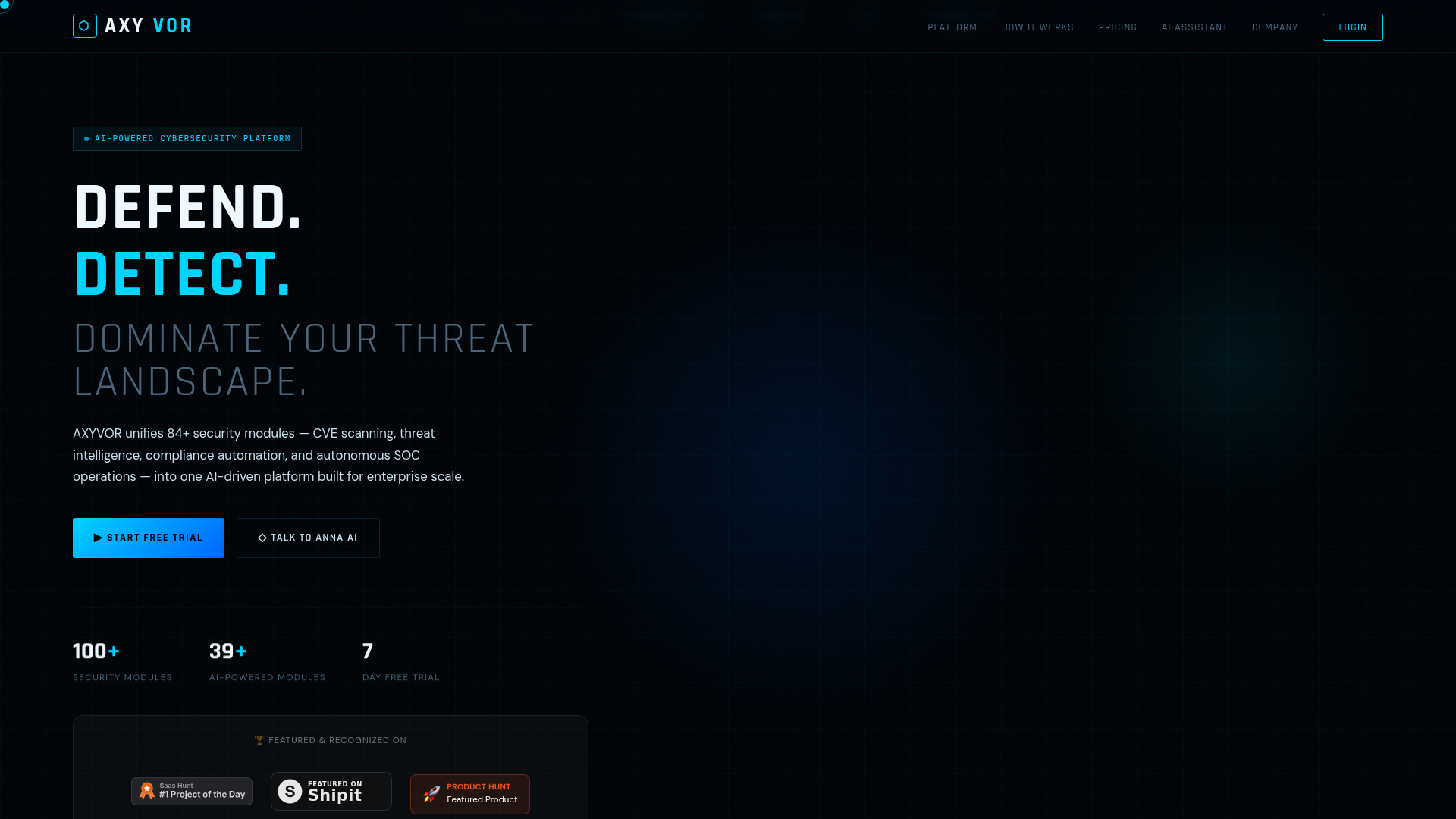
AXYVOR is an advanced AI-powered cybersecurity platform designed to unify and automate enterprise-grade security operations. It serves as a comprehensive solution for defending, detecting, and dominating the modern threat landscape, targeting security teams in Financial Services, Healthcare, Legal, and Enterprise Tech sectors, as well as growing SMBs. Key Features Unified Security Platform: Integrates 84+ security modules, including CVE scanning, threat intelligence, compliance automation, and autonomous SOC operations. AI-Driven Automation: Leverages Claude AI for threat engine initialization, remediation plan generation, and 24/7 autonomous SOC operations. Real-time Vulnerability Management: Conducts real-time CVE scanning against NIST NVD, CISA KEV, and EPSS scoring to identify exposures proactively. Comprehensive Attack Surface Mapping: Utilizes Shodan for external exposure mapping, discovering shadow IT, open ports, and misconfigured cloud assets. Automated Compliance: Streamlines evidence collection for SOC2, PCI-DSS, ISO27001, and HIPAA, generating audit-ready reports in seconds. Proactive Threat Simulation: Features Red Team AI for simulated adversarial attacks and Dark Web monitoring for leaked credentials. Use Cases AXYVOR addresses critical challenges faced by modern security teams, such as alert fatigue, slow breach detection, and the high cost of security incidents. By unifying over 84 modules into a single AI-driven platform, it provides unprecedented visibility and control, allowing organizations to move from reactive to proactive defense strategies. For instance, security teams can leverage its autonomous SOC to handle incident triage and response 24/7 without analyst burnout, significantly reducing the average 277 days it takes to detect a breach. The platform is invaluable for organizations needing to maintain stringent regulatory compliance. Its Compliance AI module automates evidence collection for frameworks like SOC2, PCI-DSS, ISO27001, and HIPAA, drastically cutting down audit preparation time. Furthermore, the Red Team AI and Dark Web Monitor enable companies to continuously test their defenses against simulated attacks and monitor for leaked credentials, ensuring they are prepared for real-world threats and protecting against the average $4.9M cost of a data breach. Pricing Information AXYVOR operates on a paid subscription model with a transparent pricing structure. It offers a 7-day free trial with no credit card required. The "Starter" plan is available at $2,500/month for SMBs, while the "Enterprise" plan, offering full platform capabilities, is priced at $12,000/month. A "Sovereign" custom plan is also available for critical sectors requiring dedicated infrastructure. User Experience and Support Onboarding with AXYVOR is designed to be quick and intuitive, guided by an AI wizard that connects cloud environments, endpoints, and SaaS tools in minutes. The platform features Anna, an AI security assistant powered by Claude AI, available 24/7 to answer questions, provide platform guidance, and assist with scheduling demos. This ensures users have immediate access to support and information, enhancing ease of use and reducing the learning curve. Technical Details AXYVOR is built as an AI-powered platform, leveraging advanced AI models like Claude AI for its core functionalities, including threat intelligence correlation, remediation planning, and autonomous SOC operations. It integrates with industry-standard security data sources such as NIST NVD and CISA KEV for vulnerability management, and Shodan for attack surface mapping. The platform supports multi-cloud security posture management for major providers like AWS, Azure, and GCP, ensuring comprehensive coverage across diverse IT environments. Pros and Cons Pros: Unifies 84+ security modules into a single platform, reducing complexity. AI-driven automation significantly enhances detection, response, and compliance. Comprehensive coverage from CVE scanning to autonomous SOC and dark web monitoring. Proactive defense capabilities with Red Team AI and real-time threat intelligence. Automated compliance evidence collection saves time and resources. Dedicated AI assistant (Anna) provides 24/7 support and guidance. Cons: Enterprise-level pricing may be a barrier for very small businesses. Extensive feature set (84+ modules) might have a learning curve for new users. No explicit mention of custom integration capabilities for the Starter plan. Relies heavily on AI, which might require trust in AI-driven decisions. Conclusion AXYVOR stands out as a robust, AI-powered cybersecurity platform that offers unparalleled unification and automation for enterprise security. By consolidating critical security functions and leveraging advanced AI, it empowers organizations to effectively defend against evolving threats, streamline compliance, and significantly reduce breach risks. Explore AXYVOR's capabilities today by starting a free 7-day trial and transform your security posture.