Website builders

Zenpage is a revolutionary, free-forever SaaS platform designed specifically for authors to create professional, high-converting websites. It empowers writers to establish a strong online presence, sell ebooks directly to readers, and cultivate their audience without incurring platform fees or commissions. Zenpage targets authors who want to take control of their online brand and sales channels, offering a simple yet powerful solution to build an author website in minutes, not days. Key Features: Free Forever: Zero cost, zero platform fees for website hosting and ebook sales. Direct Ebook Sales: Integrate with Stripe to sell PDF/EPUB files directly, keeping 100% of your revenue (minus Stripe's standard fees). Newsletter Integrations: Seamlessly connect with Mailchimp, ConvertKit, Substack, Beehiiv, Brevo, or MailerLite via real API integrations. Professional Templates: Choose from 5 professionally designed templates and 18 color schemes, crafted after real author websites. Integrated Blog: Publish content in markdown directly on your domain, complete with an auto-generated RSS feed. Automated Book Import: Type one ISBN, and Zenpage pulls your other books, covers, and buy links from Google Books. Custom Domain Support: Connect your own domain with free SSL, or use a `yourname.zenpage.io` subdomain. SEO Optimized: Auto-generated meta tags, OpenGraph, JSON-LD, sitemaps, and clean URLs ensure discoverability. Use Cases: Authors can leverage Zenpage to solve several common challenges. Firstly, it provides a centralized, professional hub for their entire body of work, moving beyond fragmented profiles on Amazon or Goodreads. This allows authors to present their books, bio, and events in a cohesive and branded environment, ensuring readers find all necessary information in one place. Secondly, Zenpage empowers authors to maximize their earnings by facilitating direct ebook sales. By connecting a Stripe account, authors can sell digital copies of their books directly from their website, bypassing traditional retailers' high commission rates. This not only increases revenue per sale but also fosters a direct relationship with readers, who receive instant delivery via email. Finally, the platform is invaluable for audience building. With robust newsletter integrations, authors can effortlessly grow their mailing lists, ensuring direct communication with their fanbase. The integrated blog further supports this by allowing authors to share updates, insights, and excerpts, keeping their audience engaged and informed about new releases or events. This direct channel is crucial for long-term career sustainability, as it reduces reliance on social media algorithms. Pricing Information: Zenpage is completely free forever, offering its core website builder and direct ebook selling features at no cost. There are zero platform fees or commissions taken by Zenpage on ebook sales; authors only pay Stripe's standard transaction processing fees (approx. 2.9% + 30c). While optional paid add-ons may be introduced in the future, existing features will remain free, ensuring no paywalls on current functionalities. User Experience and Support: Zenpage prides itself on its simplicity and speed. The user interface is designed for authors, not developers, promising a live website in just 15 minutes. There are no complex drag-and-drop builders or theme customization rabbit holes; users simply fill in their details, select a template and color scheme, and publish. The platform ensures a clean, fast, and mobile-responsive experience across all devices. While direct support channels aren't explicitly detailed, a comprehensive FAQ section addresses common questions, indicating a focus on self-service and clear documentation. Technical Details: Under the hood, Zenpage is built for performance and security. Websites are static pages, delivered via CDN, with optimized assets for sub-second load times. Security features include free HTTPS for all sites (including custom domains), DDoS protection through Cloudflare, and encrypted tokens for ebook downloads. Newsletter API keys are secured with AES-256 encryption, and images are automatically resized, compressed, and converted to WebP. SEO is handled automatically with auto-generated meta tags, OpenGraph, JSON-LD, sitemaps, and robots.txt. Pros: Truly free with zero platform fees for core features. Maximizes author revenue through direct ebook sales. Quick and easy setup (live in 15 minutes). Robust newsletter integrations for audience growth. Professional, mobile-responsive templates. Strong SEO foundation built-in. Automated book data import saves time. Secure and fast website performance. Cons: Limited design customization (no drag-and-drop). Reliance on Stripe for payment processing (standard fees apply). Potential for future paid add-ons (though existing features remain free). Specific customer support channels not explicitly outlined. No mention of advanced analytics beyond basic sales/subscriber stats. Conclusion: Zenpage offers an unparalleled, free solution for authors seeking to build a professional online presence, sell their work directly, and connect with readers. Its focus on simplicity, cost-effectiveness, and author-centric features makes it an indispensable tool for any writer looking to thrive in the digital age. Explore Zenpage today and take control of your author platform.
Docusaurus is an open-source static site generator designed to help developers and teams quickly build optimized documentation websites, blogs, and marketing pages. It empowers users to focus on content creation by leveraging modern web technologies and a pluggable architecture.Targeted at open-source projects, engineering teams, and anyone needing robust, versioned, and localized content sites, Docusaurus streamlines the process of publishing high-quality web content.Key Features Powered by MDX: Write documentation and blog posts using Markdown with embedded React components for rich, interactive content. Built Using React: Extend and customize your site's layout and functionality with familiar React components. Ready for Translations: Out-of-the-box localization support, compatible with Git, Crowdin, and other translation managers. Document Versioning: Maintain multiple versions of your documentation, keeping it in sync with project releases. Content Search: Integrated search functionality, proudly supporting Algolia for efficient content discovery. Pluggable Architecture: Design and customize your site while reusing data created by Docusaurus plugins.Use CasesDocusaurus is ideal for open-source projects like Redux, React Native, and Temporal, where maintaining comprehensive and up-to-date documentation is crucial. It allows project maintainers to easily manage content, support multiple versions, and provide localized experiences to a global audience. Companies like Supabase also leverage Docusaurus to build and maintain their product documentation efficiently, reducing the time spent on infrastructure and focusing on delivering valuable content.Beyond documentation, Docusaurus serves as an excellent tool for creating content-focused websites, personal blogs, and marketing pages. Its ability to embed React components within Markdown makes it versatile for interactive tutorials and dynamic content, while features like versioning and localization ensure scalability and reach for any content-driven initiative.Pricing InformationDocusaurus is an open-source project, making it free to use. While there's no direct pricing model, the community and project maintainers are supported through sponsorships, as highlighted by Temporal's contribution.User Experience and SupportUsers consistently praise Docusaurus for its ease of setup and use, allowing them to "focus on content" rather than complex configurations. Its intuitive approach makes it "simple to setup" and "friendly for new contributors." The project boasts a strong community with support available via Stack Overflow, Discord, and GitHub, ensuring users can find help and contribute to its ongoing development.Technical DetailsBuilt upon React, Docusaurus processes MDX files to generate static HTML, CSS, and JavaScript. This approach ensures optimized performance and easy deployment. Its pluggable architecture allows for deep customization and integration with various tools and services, making it a flexible choice for modern web development.Pros and Cons Pros: Optimized static site generation, MDX support for rich content, React extensibility, built-in localization and versioning, integrated search, strong community, easy to set up and maintain, ideal for documentation and content sites. Cons: Requires familiarity with React for advanced customization, primarily focused on static content generation (less suitable for highly dynamic, server-rendered applications without additional tooling).ConclusionDocusaurus stands out as a robust and developer-friendly solution for building and maintaining high-quality, content-focused websites. Its blend of modern web technologies, powerful features, and an active community makes it an excellent choice for anyone looking to create efficient, scalable, and well-documented online presences. Explore Docusaurus today to streamline your content delivery!

VuePress is a powerful, Vue-powered Static Site Generator designed to simplify the creation of content-focused websites. It provides a minimal setup and a markdown-centered project structure, allowing users to concentrate on writing high-quality content. It's ideal for developers, technical writers, and content creators looking to build fast, SEO-friendly documentation sites, blogs, or project websites with the flexibility of Vue.js. Key Features Simplicity First: Minimal setup with a markdown-centered project structure for easy content creation. Vue-Powered: Leverage Vue components directly within markdown and develop custom themes with Vue. Performant: Generates pre-rendered static HTML for optimal SEO and speed, then operates as a Single Page Application (SPA). Extensible Theming: Comes with a default theme, supports community themes, and allows for custom theme development. Flexible Plugin API: A robust plugin system enables easy integration of various features and functionalities. Bundler Choice: Supports both Vite (recommended) and Webpack for efficient asset bundling. Use Cases VuePress excels in scenarios where static content needs to be presented efficiently and attractively. It's an excellent choice for creating comprehensive documentation portals for software projects, open-source libraries, or internal company knowledge bases. Its markdown-first approach makes content creation straightforward for technical writers and developers alike, ensuring consistency and ease of maintenance. Furthermore, VuePress is perfectly suited for building personal blogs, portfolio sites, or marketing landing pages where performance and SEO are critical. By generating static HTML, it ensures fast load times and better search engine visibility, while the Vue.js integration allows for dynamic and interactive elements where needed, without the overhead of a traditional CMS. Pricing Information VuePress is an open-source project, distributed under the MIT License, making it completely free to use. There are no subscription fees or hidden costs associated with its core functionality. User Experience and Support The platform prioritizes a "Simplicity First" approach, making it intuitive for anyone familiar with markdown. Its clear project structure and extensive documentation, including guides on configuration, plugins, and themes, ensure a smooth onboarding process. The VuePress community actively contributes to its development and provides support, fostering a collaborative environment for users. Technical Details VuePress is built upon the Vue.js framework, leveraging its reactive capabilities for dynamic content and theme development. It generates static HTML files during the build process, which are then hydrated into a Single Page Application (SPA) on the client-side. It offers flexibility in its build pipeline by supporting modern bundlers like Vite (recommended for speed) and Webpack. Pros and Cons Pros: Highly performant and SEO-friendly due to static generation; excellent developer experience with Vue.js integration; flexible and extensible via plugins and themes; free and open-source (MIT Licensed); simple content creation with markdown. Cons: Requires some familiarity with Vue.js for advanced customization; primarily suited for static content, not a full-fledged dynamic application framework; initial setup might have a slight learning curve for non-developers. Conclusion VuePress stands out as an efficient and developer-friendly Static Site Generator, offering a perfect blend of simplicity, performance, and Vue.js power. It's an ideal solution for anyone looking to build fast, maintainable, and beautiful content-driven websites. Explore VuePress today to transform your markdown into a compelling online presence.
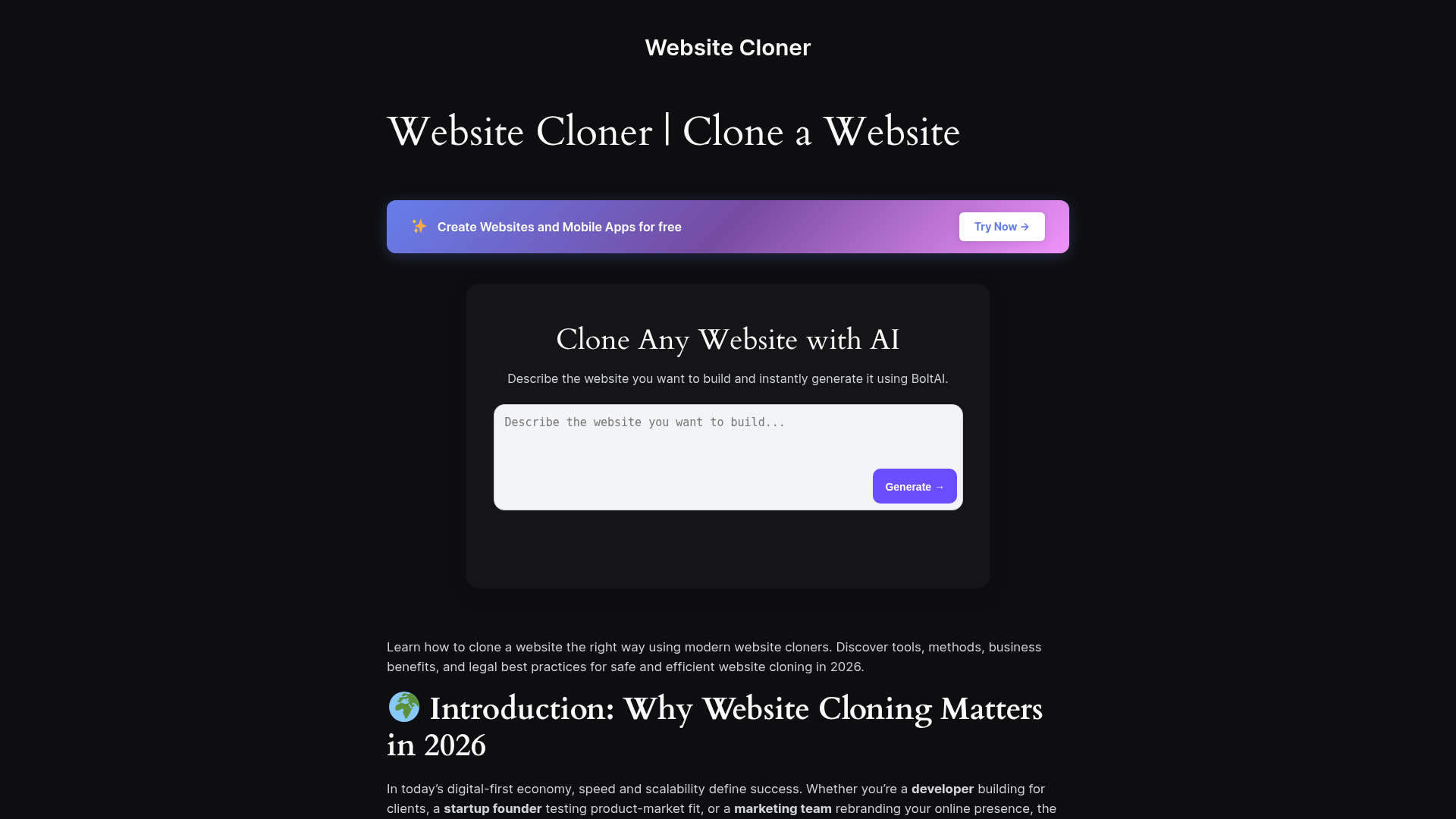
Website Cloner is an innovative SaaS platform designed to rapidly replicate the front-end design and functionality of existing websites. It empowers developers, startups, and marketing teams to duplicate website layouts, structures, and core features in minutes, significantly accelerating development and deployment processes. Targeted at businesses and individuals seeking efficiency and scalability, Website Cloner serves a wide array of use cases from testing and development to strategic market analysis. Key Features Rapid Website Replication: Clone an existing website's layout, structure, and core functionality quickly. AI-Assisted Cloning: Utilize emerging AI tools to visually interpret websites and generate editable code. Asset Mapping & Local Storage: Automatically identify, download, and store all front-end assets (HTML, CSS, JS, images). Link Rewriting: Ensure internal navigation functions correctly on cloned sites. Editable Templates: Advanced cloners generate editable templates for further customization. SEO Best Practices Guidance: Tools and strategies to optimize cloned sites for search engines. Use Cases Website Cloner is invaluable for various business scenarios. Developers can leverage it to create testing and development environments, ensuring new features are safe before deployment. For businesses undergoing a website redesign or rebranding, it provides a quick starting point, allowing teams to focus on customization rather than building from scratch. It also facilitates data migration and hosting transfers, making the process smoother and less time-consuming. Beyond technical applications, companies use Website Cloner for strategic purposes such as market and competitor analysis, ethically understanding UX flows and content hierarchy. It's also crucial for disaster recovery and backup, providing a full offline copy of a website. Furthermore, corporations can efficiently launch multi-branded or localized versions of their sites by reusing a proven framework, saving significant time and resources. Pricing Information Website Cloner offers a freemium model, allowing users to create websites and mobile apps for free to get started. Specific details on paid tiers or advanced features are not provided, but the "Try Now" option suggests an accessible entry point. User Experience and Support The platform emphasizes ease of use, particularly for SaaS-based cloners that offer a Graphical User Interface (GUI) and cloud backup features. The guide itself provides detailed steps and tool reviews, indicating a focus on user education. While direct support channels aren't explicitly mentioned, the comprehensive documentation aims to guide users through the cloning process responsibly and efficiently. Technical Details Website Cloner operates by performing HTTP crawling to retrieve HTML source code and then mapping and downloading linked assets like CSS, JavaScript, fonts, and images. It stores these files locally in a structured system and rewrites URLs for internal navigation. Advanced cloners can generate editable templates and integrate with modern frameworks such as React or Next.js, supporting Jamstack workflows for improved performance and security. Pros and Cons Pros: Accelerates website deployment and redesigns; provides robust disaster recovery and backup solutions; enables ethical competitor analysis; supports multi-branding and localization efforts; offers AI-assisted cloning for smarter development; includes SEO best practices for optimal performance. Cons: Requires careful attention to legal and ethical guidelines to avoid copyright infringement; necessitates content replacement and SEO optimization to prevent duplicate content penalties; may have a learning curve for advanced technical configurations. Conclusion Website Cloner stands as a strategic asset in the digital landscape of 2026, transforming website replication from a technical shortcut into a powerful business capability. By enabling rapid deployment, ensuring continuity, and fostering innovation, it allows teams to build, customize, and evolve faster. Explore Website Cloner today to gain a competitive edge in your digital projects.